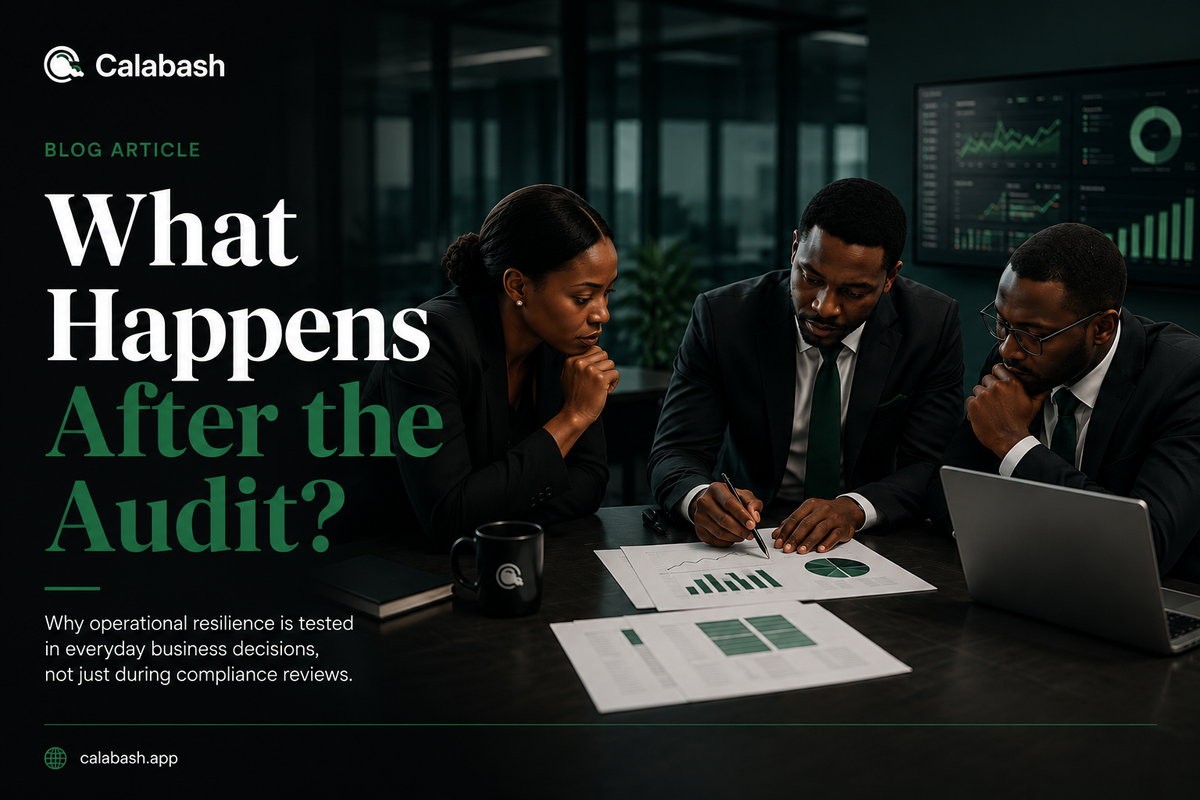
What Happens After the Audit?
Why operational resilience is tested in everyday business decisions, not just during compliance reviews.
Why operational resilience is tested in everyday business decisions, not just during compliance reviews.
Last week, an incident at a major Nigerian financial institution moved beyond a technical story within hours.
Customers wanted reassurance. The board wanted answers. Everyone wanted to know whether the institution's controls had done what they were built to do.
What starts as a technical problem quickly becomes a leadership one because resilience is ultimately judged by how an organization behaves under pressure.
Would your organization perform as confidently under pressure as it does during an audit?
The Comfort of Passing an Audit
Most organizations invest seriously in compliance.
Policies get written. Training gets completed. Evidence gets filed. Audits get passed.
But there is an important distinction.
An audit tests whether a control exists. An incident tests whether it actually works.
That is why operational resilience cannot begin and end with compliance. The real test comes afterwards, when ordinary business decisions put those controls under pressure.
The Decisions Nobody Labels as Resilience
Resilience is rarely decided in one dramatic moment. It accumulates in ordinary ones.
A supplier asks to change its bank account.
A payment crosses an approval threshold.
A contract approaches renewal.
An employee changes roles but retains previous access.
None of these feel like resilience decisions.
They feel like Tuesday.
But each one either reinforces the organization's controls or quietly weakens them.
Discipline Built Into the System
Vulnerable organizations often depend on someone remembering the procedure: the colleague who double-checks a bank account change, the manager who remembers to revoke access or the approver who notices something unusual.
Resilient organizations reduce that dependence on memory.
Approval follows authority.
Access follows responsibility.
Sensitive actions leave a record.
Critical decisions remain traceable.
Governance becomes more effective when it is part of everyday operations rather than something an organization prepares for when an audit approaches.
Leadership Cannot Delegate This
When something goes wrong, leadership needs answers:
Who approved this?
Who had access?
When did it happen?
Why wasn't it identified sooner?
Those questions reveal something bigger than the incident itself. They reveal whether leadership can trust the organization's operational information.
That trust is not created by a policy document or compliance certificate. It is built into the way the organization already works.
Where Calabash Enterprise Fits
This is the principle behind Calabash Enterprise: governance works best when it is part of operations, not a separate initiative layered on top.
When procurement, contracts, finance and reporting operate through connected processes, approvals follow defined workflows, actions create records and responsibilities remain visible.
Leadership can see what happened rather than reconstructing it afterwards.
The goal is not more controls.
It is an organization that can move quickly without losing accountability.
The Leadership Lesson
The strongest organizations do not wait for an incident to discover whether their controls work.
An audit may confirm that the controls exist. What happens afterwards reveals whether they have become part of how the business actually operates.