Coupa Navi promises 100% faster supplier discovery. FIRS and KRA are already doing the foundation work in Africa.
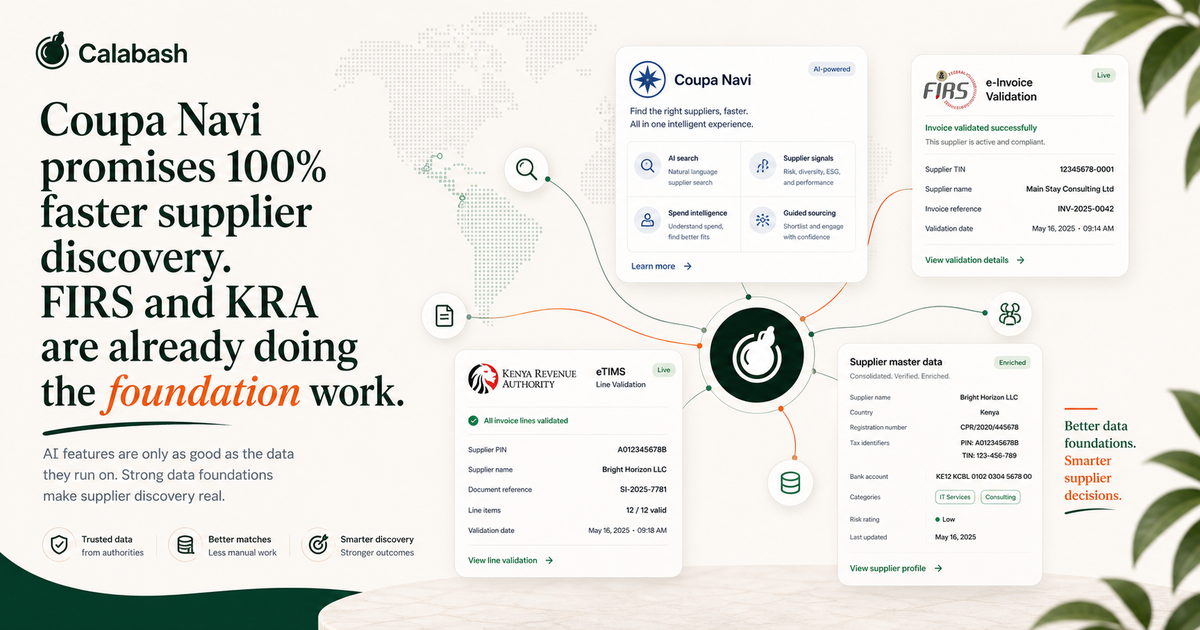
Coupa Navi promises 100% faster supplier discovery. In Nigeria and Kenya, the government is already doing the foundation work: forcing verified supplier records into existence through e-invoicing mandates. Whether that compounds into a real AP record is the only architecture decision that matters.
The Coupa Navi Supplier Discovery Agent shipped in November with a marketing line that read "up to 100% faster." The cost formula agent gets a sibling number, "up to 75% faster." A few weeks later in December they shipped Navi Agent Studio so customers can build their own. The May release added the analytics and supply chain agents. Three releases in eight months. The cadence is real and the engineering behind it is not trivial.
The part the press release does not address, and the part I want to write about from where I sit, is what the agent assumes is already there underneath it. Verified supplier records. Correct legal entity names. Bank accounts treasury actually trusts. A spend file the AP system can read.
For Coupa's enterprise customer base, those assumptions mostly hold. Master data governance is staffed. A category manager has a budget line for taxonomy maintenance. For a 200-person Nigerian manufacturer running supplier records in an ERP module plus an Excel sheet that one accountant owns, almost none of it is true. The supplier list has eighty inactive vendors no one archived. Bank accounts on file are what the supplier emailed during onboarding in 2019. Pointing an agent at that data does not make sourcing faster. It makes wrong answers arrive faster.
That has been the standard mid-market argument for a while. Foundation before agent. The bit I had wrong, and that I want to correct here, is the timeline for African corporates specifically.
The regulator is doing the unglamorous work
FIRS went live with mandatory e-invoicing for large Nigerian taxpayers, the NGN5bn-plus-turnover band, on 1 November 2025. Medium and small VAT-registered businesses follow from January 2026. The platform sits on BIS Billing 3.0 and the Peppol UBL schema, with FIRS confirmed as a Peppol Authority in September 2025. Fifty five mandatory data fields across eight categories. Penalty for non-compliance on day one is NGN1m, then NGN10k per subsequent day, indefinitely.
Kenya is on a parallel track. From 1 January 2024, any business expenditure not backed by a valid eTIMS-generated invoice has been non-deductible. From 1 January 2026, KRA started validating every income and expense line in tax returns directly against eTIMS data. Penalty is KES 1 million or ten percent of tax involved.
Read those two paragraphs again with a procurement hat on. What FIRS and KRA have actually done is force every VAT-registered supplier in two of the continent's largest economies into a structured, machine-readable existence, with verified tax IDs, correct legal entity names, and validated transaction records. They have done it on a published deadline. They have done it with penalties severe enough that the finance director's calendar moved.
That is the supplier-data foundation event that no software vendor on this continent has ever managed to sell. The revenue service just did it.
The thing I was wrong about
When I started looking at agentic procurement coverage for African corporates, I assumed the timeline question was straightforward. Africa is five to ten years behind the Coupa keynote, the argument goes, because the master data layer is not there. Build the foundation first, then talk about agents.
I was wrong about which side of the equation was binding. The foundation work is being done involuntarily, right now, by FIRS and KRA. By January 2026 in Nigeria, every supplier above the VAT threshold has a tax-authority-verified record. By the same month in Kenya, every supplier invoice has been line-validated by KRA against the buyer's expense filing. The structured supplier data that Coupa's enterprise customers spent a decade building inside the platform, the African mid-market is being handed by the revenue service.
The agent layer is not five years away. It is closer than the Coupa and Navi conversation implies. But only for shops that pipe the compliance plumbing back into AP, not into a standalone tax-compliance tool.
Where the architecture decision actually gets made
Here is the trap. The path of least resistance for a Lagos or Nairobi finance director facing the FIRS or eTIMS deadline is to buy a tax-compliance point solution that handles the integration, files the invoices, keeps the company out of penalty, and lives in a silo next to the ERP. The supplier master inside the ERP stays exactly as dirty as it was in October 2025. The clean, government-verified record sits in the tax tool. Two systems, two truths, no agent on top of either of them.
Duplo's NRS and Peppol licences from March 2026 sit in the more interesting category. They connect the ERP, generate the compliant invoice, transmit it to FIRS, and run the settlement in one flow. That is the right architectural shape. It is also AP and invoicing, not full source-to-pay. There is no native African S2P platform that I have found in public sources covering sourcing, supplier master, AP, and treasury integration in one stack. Sasol's Ariba consolidation is the canonical large enterprise reference and it took the better part of a decade.
The gap is the mid-market shop that is now structurally compliance-rich and platform-poor. The supplier record at FIRS is cleaner than the supplier record in the ERP. The treasury team still does not have a verified bank account against the supplier they are about to pay. NIBSS Name Enquiry is sitting there in Nigeria, an API call away, ready to confirm an account number against a legal name in real time, and almost nobody on the corporate AP side is wiring it into the payment-release step.
What we are building toward, honestly
Calabash does not have a production customer running this end-to-end yet. We are pre-revenue and in build mode. What I can tell you is what we are designing for. A supplier business partner record where the FIRS or eTIMS verified record is the source of truth on legal identity. A treasury-vetted bank account table, separate from what the supplier puts in their profile, that gates payment release. Workflow that records who approved what and when, with an out-of-band confirmation before the bank account on the treasury side ever moves. The compliance plumbing flowing back into AP, not away from it.
The regulators have done a year of foundation work for the African mid-market by force. The decision in front of the finance director right now is whether that work compounds into a real AP and procurement record, or stops at the tax filing.
If you are running treasury or AP at a Nigerian or Kenyan mid-market business and you want to compare what we are building against what you have today, sign up at calabash.app. Bring your current supplier master and a recent FIRS or eTIMS export. We will tell you which fields we would anchor to the verified record first, and which still need work before an agent on top would do anything useful.