Nigeria's FIRS mandate puts every invoice in structured XML. It does not touch the queue.
FIRS went live for large taxpayers in August 2025. Only 1 in 5 had onboarded by day 15. The ones who think compliance is the finish line are about to discover that structured invoices still land in manual queues when your supplier master data is dirty.
One in five.
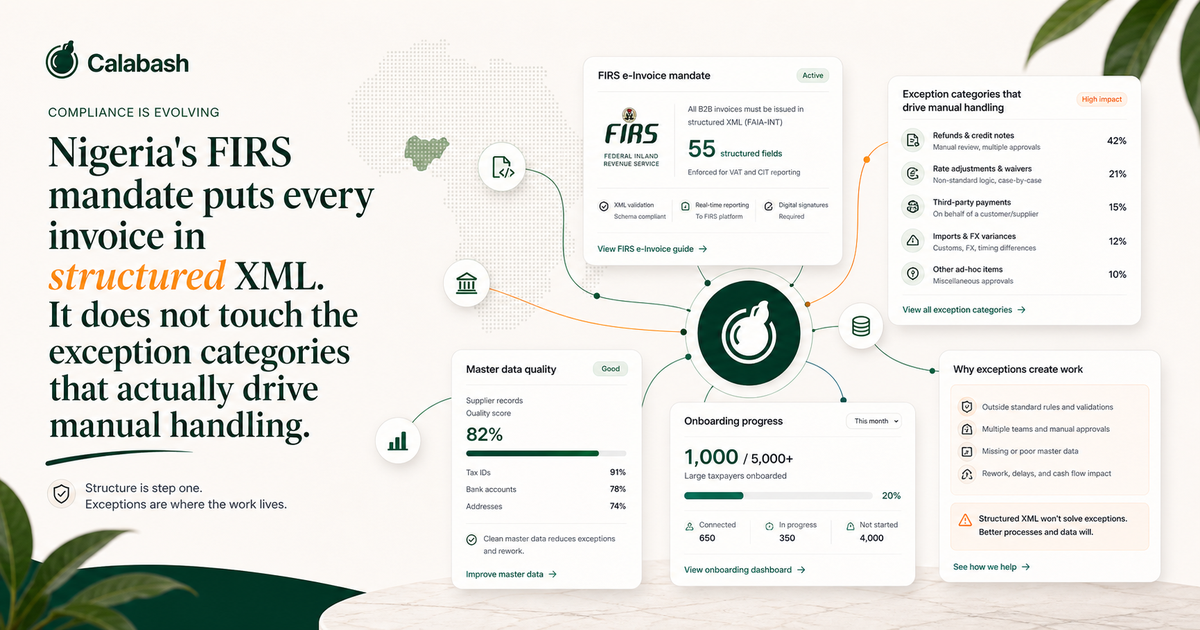
That is the share of Nigeria's large taxpayers who had finished onboarding to the FIRS e-invoicing platform by August 15, 2025, two weeks after the mandate went live. The FIRS project manager, Mohammed Bawa, told AllAfrica the running count: "Between the 1st of August to date, we have over 1,000 large taxpayers that have onboarded. We still have over 4,000 to do the onboarding." The deadline was August 1, set out in the public notice as no longer optional but mandatory. By mid-month, four out of five companies in scope had not registered. The deadline got pushed to November 1. Medium and small enterprises follow on January 1, 2026.
The trade press wrote this up as a readiness story. Eighty percent of large taxpayers missing a tax deadline is a readiness story. It is also, if you are sitting on the buyer side of the desk, the moment to ask a different question. The mandate puts every invoice into structured electronic form: 55 mandatory fields across 8 categories, XML or JSON over a RESTful API, AES-256 in transit. FIRS was added as a Peppol Authority on September 26, aligning the schema with UBL and BIS Billing 3.0. From a tax-authority point of view the digitisation is real. From a buyer's AP point of view, the question is whether any of that touches the categories that actually drive manual handling.
It does not.
What the mandate fixes and what it leaves untouched
The Ardent Partners "AP Metrics that Matter" benchmark I have written about before lands the global average for touchless invoice processing at 32.6%, with best-in-class at 49.2%. The number nobody at FIRS or in the trade coverage has done the work to publish is the African equivalent. There is no Nigeria-specific touchless rate. There is no MEA Ardent. The absence of the benchmark is a problem on its own, but it is not the problem the mandate solves either. A mandate puts structured invoices on the wire. It does not measure or shift the share of those invoices that get touched.
The categories driving the touches are the same ones the original Ardent piece called out. Bank account on the invoice does not match the master record. PO mismatch on price or quantity. Tax ID missing or wrong. GL coding to an account the buyer does not use. Credit memo that does not net against the open balance. Supplier name showing up three times in the master file because procurement onboarded the same legal entity in Lagos, in Abuja, and a third time when they re-registered the Port Harcourt branch. None of those go away because the invoice now arrives as a Peppol-compliant XML document. If anything, the 55-field schema makes the master-data tax louder. Each field is a potential mismatch point the buyer's AP system has to validate. A structurally non-compliant invoice does not arrive a bit late. It arrives rejected, which means the supplier has to fix it and resubmit, which means the buyer's payable file has a gap that did not exist before the mandate.
MTN Nigeria, Huawei Nigeria and IHS Nigeria were the named pioneer companies on the platform. Their AP teams are the first to learn this in practice. The format compliance is FIRS's bar. The data quality is theirs.
The thing I was wrong about
When I first read through the FIRS technical guidance last summer, my read was that this was going to play out like the European e-invoicing wave. The format would land, the early adopters would absorb the cost, the long tail would scramble, and within a year touchless rates would tick up because the inbound invoice was now machine-readable end to end.
That is not what the European wave actually delivered, and I knew it when I wrote down the prediction. I was lazy about it. The European mandate did raise the floor on format compliance. It did not move touchless rates the way the vendor decks promised, because the touch categories were not about whether the invoice was readable. They were about whether the upstream master record was clean enough for the automation to make a confident call. Buyers in Germany and Italy learned this the slow way. The Nigerian wave is going to learn the same thing on the same calendar.
The interesting question for a treasurer in Lagos or a procurement lead in Johannesburg in 2026 is not whether the supplier has registered with FIRS. The mandate forces that. The interesting question is whether the buyer's supplier master is in shape to receive the structured invoice without routing it to a human queue for a master-data reason. The bank account, the tax ID, the supplier legal entity name, the GL mapping, the PO discipline. If those are loose, the format change makes the queue more visible without shortening it.
What the AfCFTA and PAPSS layers add
There is another layer the FIRS mandate sits on top of, which is why I think this becomes a regional story faster than the European one did. The AfCFTA Digital Trade Protocol, adopted in February 2024 with eight annexes added in February 2025, requires member states to accept electronic documents and permit paperless trading. PAPSS, the Pan-African Payment and Settlement System, is the settlement layer underneath: 15 central banks signed on, 115-plus commercial banks connected as of mid-2024. Cross-border B2B payments inside the continent are about to start moving on rails that did not exist five years ago, with mandatory structured invoicing on one side and a settlement system that lets a Nigerian buyer pay a Kenyan supplier without bouncing through a correspondent in London on the other.
That topology is good news for African mid-market treasurers in the medium term. In the short term it stretches the master-data surface area. A buyer's supplier file that already has the duplicate-supplier and unverified-bank-account problems for domestic suppliers now has those same problems for cross-border ones, plus the question of whether the supplier is registered on the FIRS platform or on Kenya's eTIMS, and whether the structured fields on the invoice match the fields on the bank account profile, and whether the legal entity name in the AfCFTA digital identifier matches the one on the PO. The format mandate raises the bar. The master-data work to clear the bar is the work nobody is funding yet.
Where a buyer's AP team should put the next quarter
If you are running AP at a Nigerian large taxpayer or a regional buyer with Nigerian suppliers in your file, the FIRS registration is happening whether or not you are ready. The path from compliant on format to genuinely touchless on processing is the same path I have argued for in the mid-market posts in this series. Verify the bank accounts on the top fifty suppliers and store the verified record separately from the supplier-supplied one, with a treasury operator step between them. Standardise the GL mapping at the supplier level so the AP coder is not picking from a free list on every invoice. Move the tax ID validation upstream into onboarding so the FIRS structural rejection does not bounce the invoice back the day before payment is due. Close the duplicate-supplier problem in the master file. Pull the AP and AR teams into the same room at least once before January 1, because the Fonoa team's line about Ghana, that AP and AR teams are so far apart they do not even know each other, applies to most of the buyers I have spoken to in this region too.
None of this needs a platform migration. All of it needs the master record to be true. The mandate did the format work. The master-data work is yours.
If you want to compare what we have been building on the master-data and verification side against what you have today, sign up at calabash.app. Bring a sample of ten FIRS-onboarded suppliers and the bank account fields you currently hold on them, and we will walk through which of those fields would pass the structural check, which would not, and which would land but produce a manual touch on the way through. The honest framing is the only framing that travels in this category. We have not stopped saying that since the first post in the series.