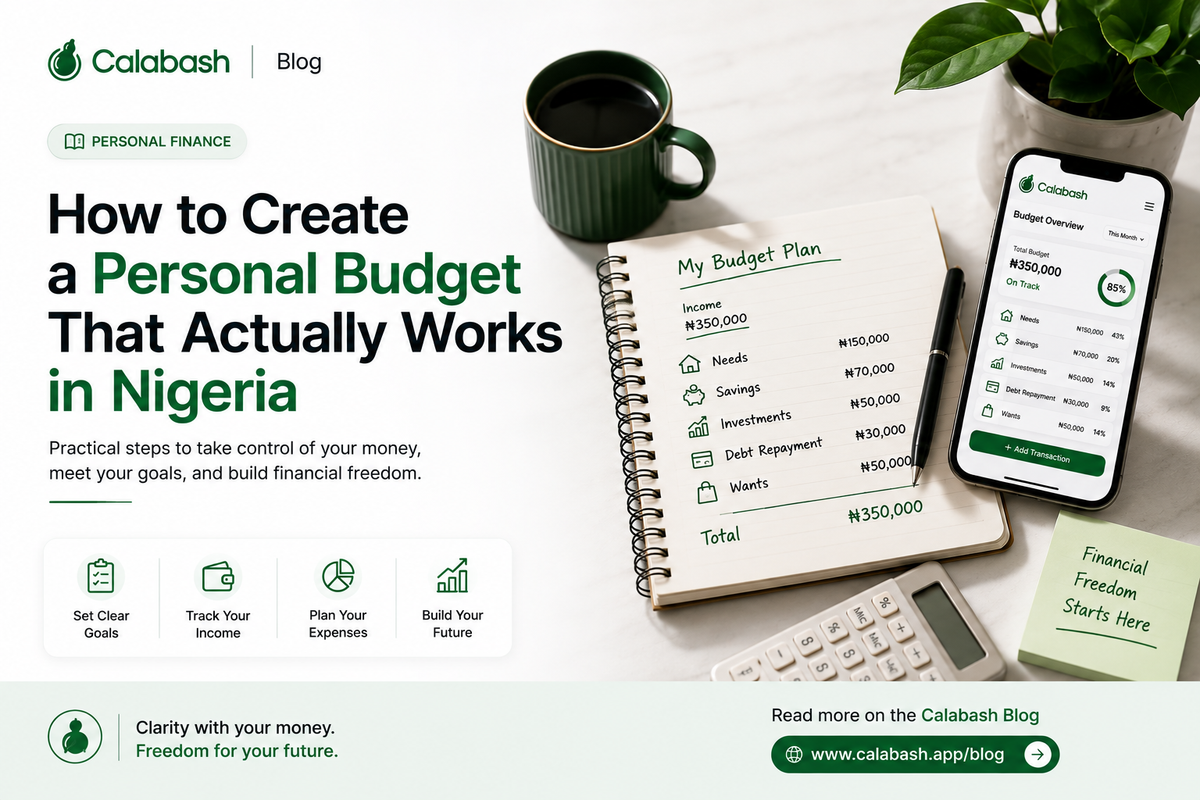
How to Create a Personal Budget That Actually Works in Nigeria
Most budgeting advice tells you to allocate a percentage of your income to different categories. Fifty percent to needs. Thirty percent to wants. Twenty percent to savings. It sounds clean and logical. But it rarely accounts for the reality of living in Nigeria
Justice was good with money. At least, that is what she told herself.
Every month on payday, she would sit at her desk with the best of intentions. She would mentally split her salary, tell herself this is the month she saves, and feel genuinely optimistic about the weeks ahead. And then, almost without noticing, the money would be gone. Not wasted on anything dramatic. Not spent recklessly. Just gone. Two weeks before the end of the month, she would open her banking app and feel that familiar sinking feeling.
She had tried everything. She had downloaded budgeting apps that she stopped using after three days. She had kept a notebook that fell apart by week two. She had made spreadsheets so complicated they gave her a headache just looking at them. None of it stuck. And every month, the cycle repeated itself.
If you have ever felt exactly what Justice felt, you are not alone. And more importantly, the problem is almost certainly not you. The problem is the approach.
Why Most Budgets Fail Before the Month is Even Over
Before we talk about how to create a personal budget that actually works in Nigeria, it is worth understanding why so many budgets fail in the first place. Because if you have tried budgeting before and given up, the reason is almost always one of the following:
The Budget Was Built on Ideal Numbers, Not Real Ones
Most budgeting advice tells you to allocate a percentage of your income to different categories. Fifty percent to needs. Thirty percent to wants. Twenty percent to savings. It sounds clean and logical. But it rarely accounts for the reality of living in Nigeria, where transportation costs spike unpredictably, data prices eat into your daily budget, family financial obligations arrive without warning, and inflation means what N5,000 covered last month barely covers half of that today.
There Was No System to Track What Actually Happened
Creating a budget is only the first half of the work. The second half is tracking your actual spending against it in real time. Most people create a budget at the beginning of the month and then have no reliable system to monitor whether they are staying within it. By the time they check, it is too late.
The Budget Was Too Complicated to Maintain
Any financial system that requires more than a few minutes a day to maintain will eventually be abandoned. Human beings are not naturally disciplined in the face of complexity. The best personal budget is the simplest one that still gives you a clear and accurate picture of your money.
There Was No Room for the Unexpected
A budget that has no buffer for unplanned expenses is a budget that will break. In Nigeria especially, unexpected costs are not occasional occurrences. They are a regular part of life. Any realistic personal budget must account for this.
The Real Cost of Not Having a Personal Budget in Nigeria
Beyond the month-end stress and the painful bank balance checks, the absence of a personal budget has real, compounding financial consequences that most people underestimate.
• You consistently spend more than you earn without knowing it until it is too late to adjust.
• Savings become whatever is left over rather than a deliberate financial decision, which usually means there is nothing left to save.
• Financial goals like rent, school fees, travel, and investment get pushed forward month after month because there is never enough, even when your income could support them.
• Debt accumulates gradually through small, untracked borrowing decisions that feel manageable individually but become overwhelming collectively.
• Financial stress becomes a constant background noise affecting your mental health, your relationships, and your ability to focus on the things that matter most.
None of these outcomes are inevitable. They are the natural result of operating without a system. And the good news is that the system does not have to be complicated.
How to Create a Personal Budget That Actually Works in Nigeria
Here is a practical, honest framework for building a personal budget that reflects your real life, survives contact with a Nigerian month, and gives you genuine control over your finances.
- Know Your Actual Monthly Income: Before you can budget a single naira, you need to know exactly how much money is coming in. For salary earners, this is straightforward. For freelancers, business owners, or anyone with variable income, take an average of the last three months and use the lower figure as your baseline. Being conservative here protects you. Being optimistic here destroys your budget before it begins.
- Track Every Expense for One Full Month Without Changing Anything: This step is not about restriction. It is about reality. Before you build a budget, you need to understand your actual spending patterns, not what you think they are. Track every expense, every day, for one full month. No filtering. No judgment. Every shawarma, every transport fare, every airtime top-up, every bank charge. What you discover will almost certainly surprise you. And that surprise is the most valuable financial data you have ever gathered about yourself.
- Categorise Your Spending Into Three Buckets: Once you have a month of real data, sort every expense into three categories. The first is fixed obligations, things that are the same every month: rent, loan repayments, subscriptions, and regular transfers. The second is variable necessities: food, transport, utilities, and personal care. These change month to month but are not optional. The third is discretionary spending: entertainment, eating out, online shopping, and anything that is a choice rather than a necessity. Knowing the size of each bucket is the foundation of every good budget.
- Set Realistic Spending Limits Based on Your Real Data: Now set your budget limits, but base them on what you actually spent, not what you wish you spent. If you spent N45,000 on food last month, setting a food budget of N15,000 will fail immediately. Instead, set N40,000 as the target and work to reduce it gradually over time. Small, sustainable changes outperform dramatic cuts every single time. Build in a buffer of 10 to 15 percent of your total budget for unexpected expenses. In Nigeria, this is not optional. It is essential.
- Treat Savings as a Fixed Obligation, Not an Afterthought: The most important shift in personal finance is moving savings from the end of your budget to the beginning. Decide on a savings amount first, before you allocate anything else, and treat it with the same priority as your rent. Even if the amount is small to start, the habit of paying yourself first before spending is the single most powerful financial decision you can make. Automate it if you can. Remove the option for it to be skipped.
- Review Your Budget Weekly, Not Monthly: Monthly reviews are too infrequent. By the time you check in at the end of the month, there is nothing you can do about the money that has already left. A weekly budget review, which takes less than ten minutes with the right system, lets you catch overspending early and adjust before it becomes a problem. This is the difference between a budget that guides you and one that just documents your failures.
Back to Justice and What Changed
Justice did not change her income. She did not get a raise. She did not cut out everything that brought her joy. What she changed was her system.
She stopped trying to remember what she spent and started capturing it automatically. She stopped building complicated spreadsheets she would never maintain and started using a tool that did the work for her in real time. She stopped guessing where her money was going and started seeing it clearly, every day, in one place.
Within her first month using Calabash, she discovered she was spending N28,000 a month on things she had categorised in her head as small and occasional. She found three subscriptions she had completely forgotten about. She realised she was spending twice as much on food delivery as she had estimated. None of this required more discipline. It just required visibility.
With that visibility came control. And with control came the ability to make real financial progress for the first time.
How Calabash Makes Personal Budgeting Simple and Sustainable
Calabash is a smart spend and expense management platform designed for the way Nigerians actually manage their money. It does not ask you to change your habits overnight. It meets you where you are and gives you the tools to gradually take control.
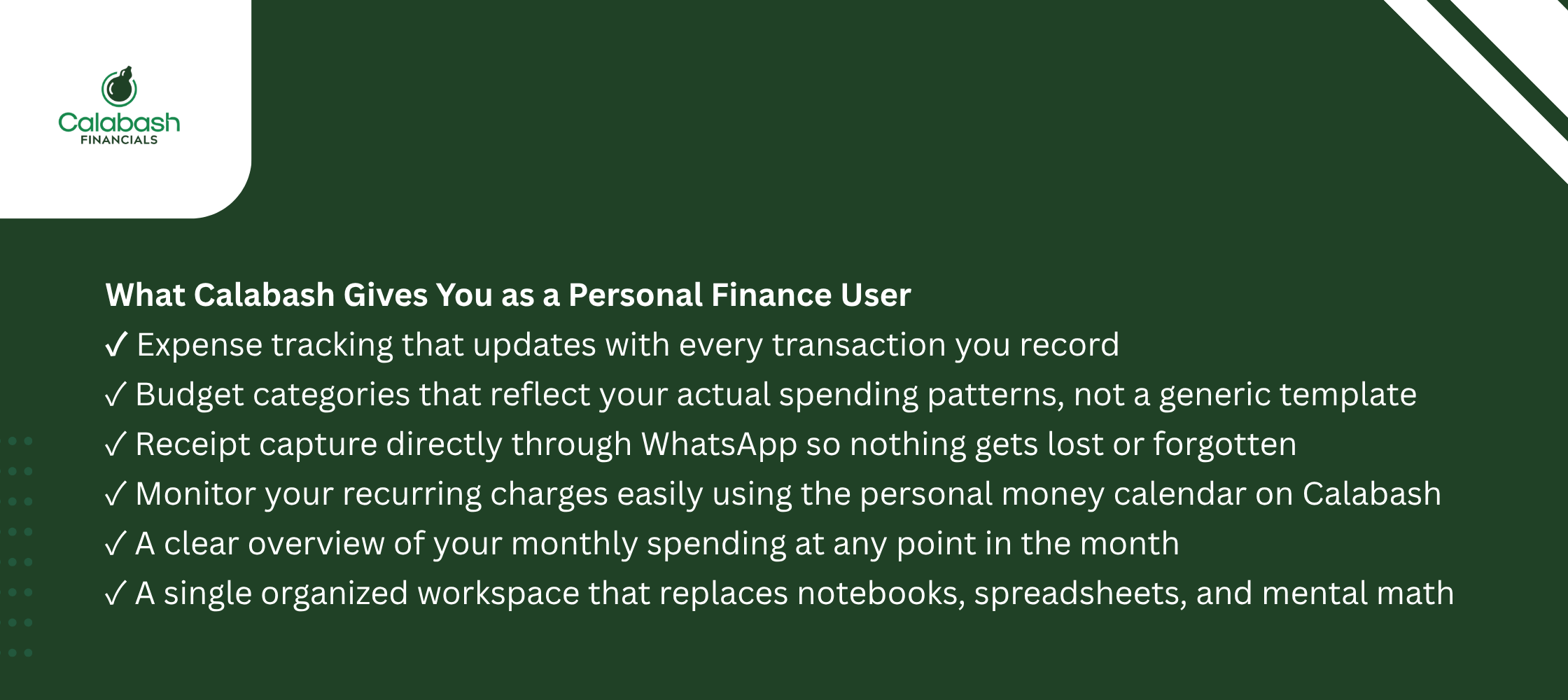
The result is not just a budget. It is a financial picture that is always current, always accurate, and always available the moment you need it.
Common Personal Budgeting Questions Answered
How much of my income should I save each month?
The honest answer is: as much as you can sustainably maintain. The popular advice of saving 20 percent of your income is a useful target but not always realistic depending on your circumstances. Start with whatever amount you can commit to consistently, even if it is N5,000 a month. The habit matters more than the amount in the early stages. Increase it as your income grows or your fixed expenses reduce.
What is the best budgeting method for someone with a variable income in Nigeria?
For anyone with inconsistent monthly income, the most effective approach is zero-based budgeting adapted for variability. Budget from your lowest expected monthly income, not your highest or average. Any month where you earn above that baseline, direct the surplus immediately to savings or financial goals before it gets absorbed into spending. This approach protects you in low-income months and accelerates your progress in high-income ones.
How do I budget when I have black tax and family financial obligations I cannot predict?
Black tax and family obligations are one of the most significant and underacknowledged budget disruptors for Nigerians. The most practical approach is to create a dedicated family obligations category in your budget and allocate a realistic monthly amount to it, based on historical patterns. Having a buffer specifically for this purpose means that when the obligation arrives, it comes out of an allocated category rather than derailing your entire budget.
How long does it take to see results from budgeting?
Most people begin to feel a meaningful difference within 60 to 90 days of consistent budgeting. The first month is almost entirely about gathering data and building awareness. The second month is where adjustments begin to take effect. By the third month, the habit is forming and the financial picture is noticeably clearer. The key is consistency over perfection. A budget you maintain imperfectly every month is infinitely more valuable than a perfect budget you abandon after two weeks.
Your Next Step
Justice's story is not unusual. And neither is the transformation that came from having the right system in place. The gap between where most Nigerians are financially and where they want to be is rarely a gap in income. It is almost always a gap in financial visibility.
A personal budget built on real data, tracked consistently, and reviewed regularly is the most powerful financial tool available to anyone at any income level. And Calabash is the platform that makes all of that possible without the complexity, the spreadsheets, or the stress.