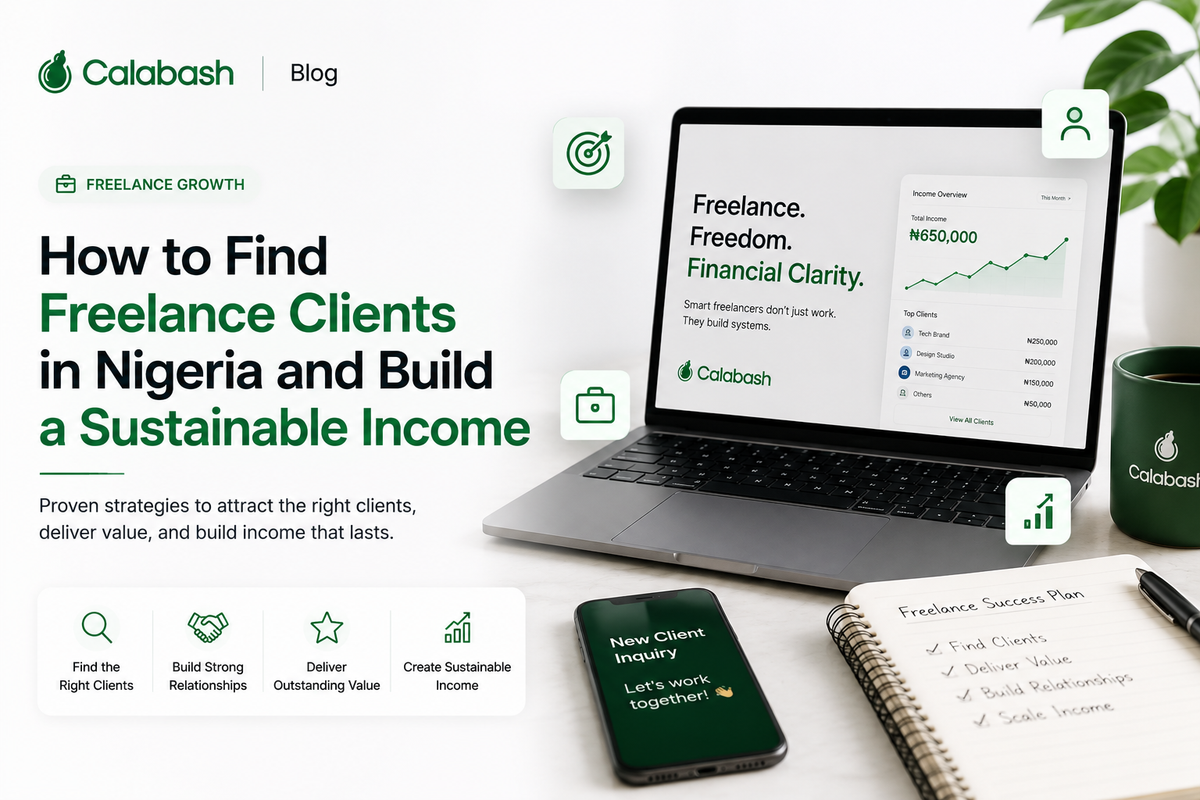
How to Find Freelance Clients in Nigeria and Build a Sustainable Income
Where Nigerian freelancers are actually finding quality clients, what makes them convert, and how to build a pipeline that does not dry up between projects.
Emeka had been freelancing for eleven months when he almost quit. Not because he was bad at what he did. If anything, the problem was the opposite. Every client who had worked with him came back. The feedback was consistently strong. His work was professional, delivered on time, and worth every naira charged. By every measure of skill, Emeka was ready for a serious freelance career.
But skill alone was not paying his bills. The real problem was a pipeline that looked like a feast-or-famine rollercoaster. One month he had three clients at the same time and could not keep up. The next two months he had nothing, watching his savings slowly shrink while sending proposals into what felt like a void. He had no system for finding clients consistently. He was reacting to opportunities when they appeared rather than building a reliable flow of work.
This is the most common and least talked-about challenge in freelancing in Nigeria. Not the skill gap. Not the imposter syndrome. Not even the client who ghosts after the work is delivered. The real challenge is building a client pipeline that generates sustainable, predictable freelance income month after month, regardless of what happened last month.

Why Finding Freelance Clients in Nigeria Feels So Hard
The Nigerian freelance market is growing faster than ever. More businesses are outsourcing work. More companies are open to remote collaboration. More individuals are building personal brands and content operations that need professional support. The demand for skilled freelancers is genuinely there.
And yet the majority of Nigerian freelancers still struggle to find enough quality clients. Here is why:
They Are Visible in the Wrong Places
Most freelancers set up profiles on every platform they hear about and then wait. Waiting is not a client acquisition strategy. Visibility without positioning is noise. Being present on a platform is only the beginning. The freelancers who win clients consistently are the ones who are visible in the specific places their ideal clients are already looking, with a profile and a presence that communicates expertise immediately.
They Lead With Skills Instead of Outcomes
When a potential client reads a freelancer's profile or proposal and sees a list of technical skills, they have to do the mental work of connecting those skills to their own problem. When they read about outcomes, results, and specific value delivered to businesses like theirs, the connection is instant. Most Nigerian freelancers are selling what they do rather than what they make happen for the people who hire them.
They Have No Follow-Up System
The majority of freelance work is not won on the first contact. A potential client sees your profile, visits your website, reads your proposal, and then gets pulled away by thirty other things happening in their business. Without a structured follow-up approach, that warm lead goes cold and the work goes to whoever showed up again. Most Nigerian freelancers never follow up.
They Do Not Look Professional Enough to Be Taken Seriously
This is uncomfortable but important. In a market where clients cannot physically meet you before hiring, professionalism is communicated entirely through your digital presence. A polished profile, a professional invoice, a clear payment process, and a well-structured proposal all signal to a potential client whether you run a serious operation or an informal one. Informality costs Nigerian freelancers more work than any skills gap ever has.
Where Nigerian Freelancers Are Actually Finding Quality Clients in 2026
There is no single platform that works for every freelancer in every niche. What matters is understanding which channels match your service type, your experience level, and the kind of client relationship you want to build. Here is an honest breakdown of where Nigerian freelancers are winning work right now:
Best for: Mid-level and senior Nigerian freelancers offering professional services such as consulting, writing, design, marketing, and business support to corporate and SME clients.
Calabash tip: Every client you successfully complete work for should become a LinkedIn connection. A recommendation from a satisfied client on LinkedIn is one of the highest-converting trust signals available to a freelancer. Track every client contact and invoice date in Calabash so your professional records match the professional image you project.
- Upwork
Best for: Experienced Nigerian freelancers in technical fields such as development, data analysis, design, and content who want access to international clients and USD earnings.
Calabash tip: International clients paying in dollars need to see a professional invoice and a clear payment process. Calabash lets you send invoices and track income by client in a single workspace, making your international earnings as organized as your local ones.
- Fiverr
Best for: Freelancers with clearly defined, packaged services such as logo design, video editing, copywriting, and social media content who want clients to come to them rather than bidding for work.
Calabash tip: Fiverr income can be irregular in timing. Calabash tracks every payment received, flags when client payments are due, and gives you a real-time view of your Fiverr earnings alongside all your other income sources so you always know your true monthly revenue.
- PBridge and Local Nigerian Platforms
Best for: Freelancers who want Naira-denominated work from Nigerian businesses without the complexity of international payment platforms.
Calabash tip: Local clients paid in Naira often have informal payment habits. Sending a professional invoice through Calabash with a clear due date and a payment link changes the dynamic immediately and dramatically reduces the time it takes to get paid.
- WhatsApp and Direct Referrals
Best for: Freelancers at every level. Word of mouth through WhatsApp groups, alumni networks, and professional communities remains one of the highest-converting client channels in Nigeria.
Calabash tip: Referral clients arrive warm but can become the most chaotic to manage if you have no system. When a referral client comes in through WhatsApp, create their profile in Calabash immediately so their invoices, payments, and project history are organized from day one.
- X / Twitter and Instagram
Best for: Creative freelancers such as writers, designers, photographers, and marketers who build an audience around their expertise and attract inbound client inquiries through consistent content.
Calabash tip: Social media clients often start small and grow into long-term retainers. Calabash lets you track income by client so you can see exactly which social media relationships are generating the most revenue over time and invest your energy accordingly.
The Mistake That Keeps Most Nigerian Freelancers Stuck
Here is the pattern that repeats itself constantly among Nigerian freelancers who are not growing as fast as they should be:
They get a client. They deliver the work. They move on to finding the next client. They get another client. They deliver the work. They move on again. Month after month, the same cycle. Always hunting. Never building.
The problem is that every new client is treated as a transaction rather than the beginning of a relationship. And relationships, in freelancing, are the only sustainable source of income.
The Nigerian freelancers who build six-figure and seven-figure annual incomes are not better at finding new clients than everyone else. They are better at keeping the clients they already have and turning one project into an ongoing relationship. They follow up after delivery. They check in a month later. They send a relevant article or a useful observation. They make the client feel remembered and valued. And when that client has more work or knows someone who needs similar help, they know exactly who to call.
How to Build a Freelance Client Pipeline That Does Not Dry Up
A pipeline is not a list of platforms. It is a system that moves potential clients from awareness to hire consistently and predictably. Here is how to build one that works in the Nigerian freelance market:
Step 1: Define Exactly Who You Serve and What Problem You Solve
The broader your target client, the weaker your positioning. A freelance writer who writes for everyone is less compelling than a freelance writer who specialises in financial content for Nigerian fintech startups. Niching down feels counterintuitive because it seems to reduce your potential market. In practice, it dramatically increases your conversion rate because potential clients immediately recognize that you understand their specific world.
Step 2: Optimize One Channel Before Adding More
The temptation is to be everywhere at once. Upwork, Fiverr, LinkedIn, Twitter, Instagram, and three Nigerian platforms simultaneously. The result is a thin, inconsistent presence on every platform that converts on none of them. Pick the one channel most likely to reach your ideal client and go deep on it until it is generating consistent inquiries. Then and only then add a second channel.
Step 3: Build a Portfolio That Speaks Before You Do
Your portfolio is your most powerful sales tool. For Nigerian freelancers without an extensive client list, this means creating case studies from personal projects, pro bono work for organisations you believe in, or detailed breakdowns of how you would approach a specific client's problem. What matters is that a potential client can look at your portfolio and immediately understand the quality of your thinking and the results you produce.
Step 4: Follow Up Relentlessly but Professionally
Every proposal you send without a follow-up is a missed opportunity. Every potential client who went quiet is not necessarily disinterested, they are busy. A professional, polite follow-up email three to five days after a proposal is not desperate. It is professional. Most Nigerian freelancers never follow up even once. The ones who do consistently win more work than those who simply wait.
Step 5: Make Every Existing Client a Referral Engine
At the end of every completed project, ask your client directly whether they know anyone else who might benefit from similar work. This single habit, practiced consistently, is responsible for a significant proportion of the income of Nigeria's highest-earning freelancers. People who have just experienced excellent work are primed to refer. The window is short. Use it.
Step 6: Track Everything So You Know What is Working
A pipeline you cannot measure is a pipeline you cannot improve. Which platform is generating the most client inquiries? Which type of project converts from proposal to paid work most reliably? Which clients spend the most over time? Without answers to these questions, every decision about where to invest your time and energy is a guess. With answers, every decision is a strategy.
Back to Emeka, and the System That Changed Everything
Emeka did not find a magic platform. He did not suddenly get lucky with a viral post. What changed was that he stopped treating freelancing like a series of disconnected jobs and started treating it like a business.
He picked one primary channel, LinkedIn, and committed to posting genuinely useful content for the kind of clients he wanted to attract twice a week. He updated his profile to speak directly to outcomes rather than skills. He started following up on every proposal within five days. And he began tracking every client relationship, every invoice, every payment, and every piece of income in one organized system.
Within 90 days, three things happened. His inquiry rate increased because his positioning was sharper. His conversion rate improved because his follow-up process was consistent. And his income became more predictable because he could finally see his pipeline clearly, know which clients were active, which invoices were outstanding, and exactly what he had earned versus what was still owed.
The tool that made all of that organization possible was Calabash.
How Calabash Supports Nigerian Freelancers Who Are Serious About Growth
Finding clients is only the beginning. What separates a freelancer who earns inconsistently from one who builds a real income is the ability to manage the business side of freelancing with the same quality as the creative or technical work. That is exactly where Calabash comes in.
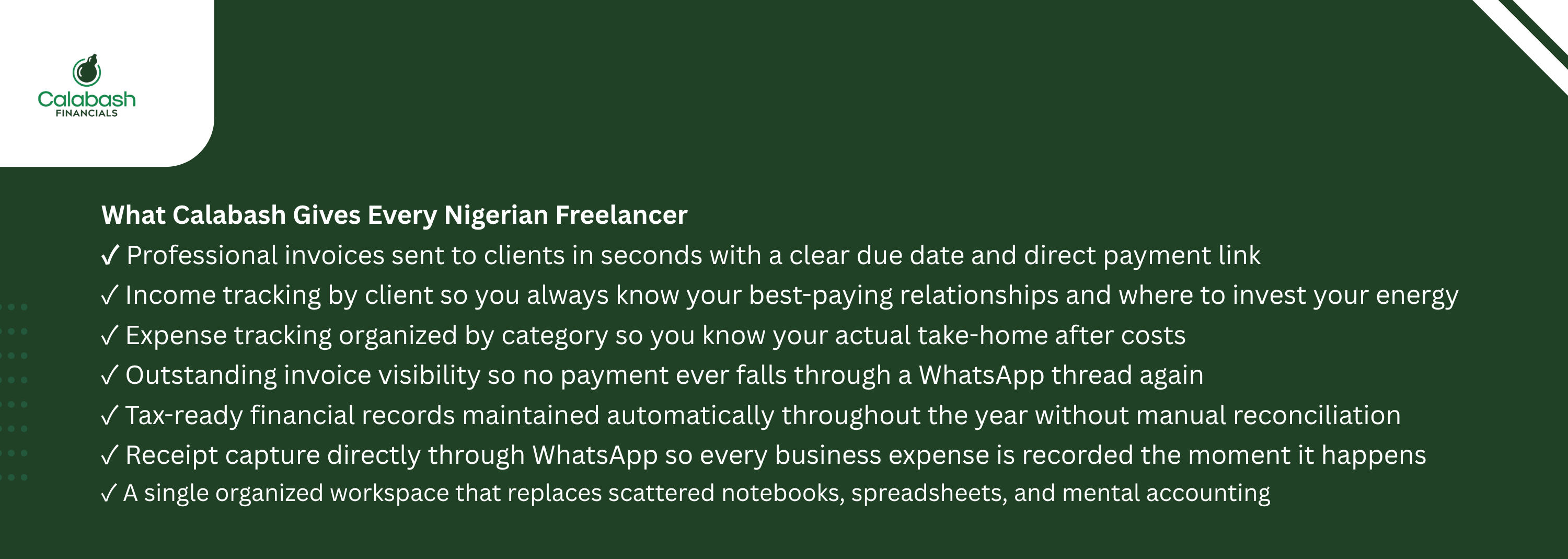
The client acquisition strategies in this post will bring opportunities to your door. Calabash makes sure that when those opportunities convert to paid work, every naira earned is tracked, every invoice is followed up, and your freelance business runs with the financial clarity of an operation ten times its size.
Frequently Asked Questions About Freelancing in Nigeria
How do I find my first freelance client in Nigeria with no experience?
Start with your immediate network. Former colleagues, classmates, family members with businesses, and community connections are all potential first clients. Offer to do a small project at a reduced rate in exchange for a detailed testimonial and a portfolio piece. The goal of your first client is not maximum income. It is proof of work that makes the second client easier to find. Once you have one piece of work to show, every subsequent conversation becomes significantly easier.
Is freelancing in Nigeria sustainable as a full-time career?
Absolutely, but only for freelancers who treat it as a business rather than a series of gigs. The Nigerian freelancers earning full-time incomes consistently have three things in common: a clear niche, a reliable client acquisition channel, and a financial system that gives them visibility into their income and expenses. Without all three, freelancing will always feel precarious regardless of how talented you are.
How do I get international clients as a Nigerian freelancer?
Upwork and Fiverr remain the primary entry points for international client work. LinkedIn is increasingly valuable for mid-level and senior Nigerian freelancers targeting corporate international clients. The key to converting international clients is demonstrating professionalism at every touchpoint: your profile, your proposal, your communication speed, and your invoicing and payment process. International clients are accustomed to working with professional operations. Every detail of how you present and manage yourself either confirms or undermines that expectation.
How do I handle clients who do not pay on time?
The most effective solution is a system that prevents late payment rather than one that reacts to it. Sending a professional invoice with a specific due date and a direct payment link immediately after project completion, followed by a polite reminder three days before the due date, dramatically reduces late payment rates. When payment is overdue, a firm but professional follow-up within 24 hours of the due date signals that you track your receivables and take them seriously. Clients who sense that you are not watching tend to deprioritize your payment.
Freelancing in Nigeria has never had more potential than it does right now. The platforms are there. The demand is real. The opportunity to build a genuinely sustainable income from your skills is available to anyone willing to approach it with the seriousness it deserves.
But talent alone will not build your pipeline. Showing up on every platform will not pay your bills. What builds a lasting freelance career is a combination of sharp positioning, consistent visibility in the right places, professional systems that make clients trust you, and financial clarity that lets you make smart decisions about where to invest your time and energy.
Emeka figured that out. Thousands of Nigerian freelancers are figuring it out right now. And the ones moving fastest are the ones who stopped leaving their finances to chance and started running their freelance work like the business it actually is.
Calabash was built for exactly that. Send professional invoices, track every client payment, manage your expenses, and see your real freelance income at any moment without the spreadsheets, the WhatsApp chaos, or the end-of-month guesswork.
Your skills got you this far. The right system will take you the rest of the way.
Sign up free at www.calabash.app and start building the freelance business your work deserves.