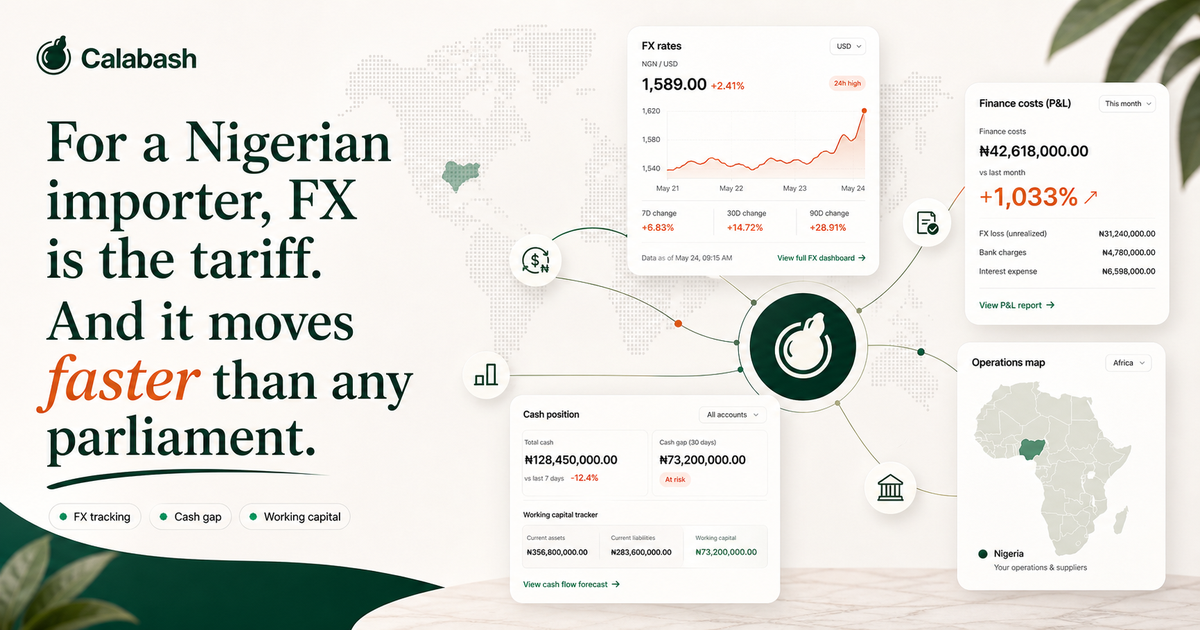
For a Nigerian importer, FX is the tariff. And it moves faster than any parliament.
When the naira moved 36% in a week in June 2023, every Nigerian importer with a USD-denominated AP book had a cash-gap problem their quarterly forecast had not modelled. The African version of the tariff-shock story is older, larger, and structural — it is called FX.
Thirty six percent.
That is what the naira lost against the dollar in seven days in June 2023, after the Central Bank unified the FX market. The official rate went from N464.5 on the thirteenth to N708.2 on the twenty first. By January 2024 it was N1,455. By the end of 2024 it closed at N1,535, down another 40.9% on the year. A treasurer in Lagos who signed off a quarterly cash forecast in May 2023 was working from a rate that had moved by more than a third before the deck reached the CFO's inbox.
The original GTreasury piece that has been circulating in US treasury press uses an illustrative $12 million cash gap at a global electronics importer to make a point about tariffs. Treat that number as a shape, not a name. The shape is a finance team that thought it had a clean view of the next two quarters, opened the spreadsheet, ran the new assumption, and found a hole the size of a covenant breach. The point of the post was never the company. It was the shape.
The shape is the same in Lagos. The cause is not.
The macro number, because the named one does not exist
I went looking for a named mid-market Nigerian importer with a specific figure in the same illustrative shape as the GTreasury electronics case. I did not find one, and I am not going to invent one. What is in the public record is the macro version, and it is bigger than the US story by an order of magnitude.
Ten of Nigeria's largest listed companies, including MTN Nigeria, Nestlé, Dangote, BUA, and Nigerian Breweries, recorded a combined N1.7 trillion in foreign exchange losses in 2023. Seven listed consumer goods firms posted N839.24 billion in FX losses against N4.64 trillion in revenue, which is 18.06% of the top line gone to a rate move. Finance expenses for the same seven consumer goods companies surged from N32.18 billion in Q1 2023 to N465.11 billion in Q1 2024. That is a 1,345% year-on-year increase in finance costs. Not a typo.
Nestlé Nigeria is the named case that does most of the work in this story. Finance costs at the listed entity rose from N20.5 billion in 2022 to N232.4 billion in 2023, an increase of N211.9 billion. The MD, Wassim Elhusseini, wrote it down plainly in the full year statement: "The devaluation of the Nigerian Naira in 2023 which led to a revaluation of our foreign currency obligations undoubtedly impacted our financing cost and consequently the profit after tax." The company swung from a N71.1 billion profit before tax to a N104.0 billion loss. The full year 2024 FX loss came in at N290.7 billion. Airtel Africa, listed in London and exposed to the naira through its Nigerian operating company, posted a $89 million net loss for the year to March 2024 against the prior year's profit, with $1,070 million in derivative and foreign exchange losses on the line, $807 million of which the company classified as exceptional and attributable to the June 2023 devaluation.
These are the public companies. They have hedging desks, dollar credit lines, Big Four advisers on the phone, and currency overlays the mid-market does not. They wrote down those losses anyway. The mid-market importer running a smaller order book with no hedge, paying USD invoices out of naira receivables and a 40 to 60% supplier advance to lock in the slot, ran the same problem at a worse scale with worse tools.
The forecast was wrong before it was published
The mechanism is identical to the tariff story in the original post and worse in the timing. A mid-market cash forecast runs on a quarterly cycle. AP commitments from the ERP, AR aging, capex schedule, an FP&A working capital assumption, a deck. The deck is right on the day it is signed. The forecast it sits on is already three to six weeks old when the CFO opens it.
In a steady year, the drift between forecast and actual is small. In June 2023, the drift was 36% in seven days on the rate that priced every single USD-invoiced commitment on the AP book. A Lagos treasurer reading the new official rate on the twenty first of June was looking at a payable file that needed to be re-translated line by line. The supplier advance that had been quoted in dollars three weeks earlier needed roughly half as much naira again to settle. The letter of credit that had been collateralised at one rate needed topping up. The forecast that had said the next quarter was funded did not say that any more.
I had assumed when we started building Calabash that an FX-shock layer on top of the cash forecast was an enterprise problem. Something the listed companies handled with their treasury management system and the mid-market did not really need. I was wrong about the mid-market piece. The treasurers I have spoken to in Lagos and Abuja over the last year all ran a version of the same workflow during 2023 and 2024. Spreadsheets. No hedge. Catching the rate move after the supplier emailed to ask why the wire had not landed.
The customs layer, because one shock was apparently not enough
In February 2025 the Nigeria Customs Service introduced a 4% FOB levy on all imports, up from the 1% CISS charge it had been running. The levy was suspended after pushback, then reinstated effective the fourth of August 2025, then suspended again. The Manufacturers Association of Nigeria put out a statement warning that the 4% line would push raw material import costs above the N6.6 trillion baseline recorded in 2024 and that machinery and inputs not available domestically would be hit hardest.
Whether the 4% line is in force this quarter or not is genuinely uncertain. That is the point. For a Nigerian importer with USD payables, neither the customs charge nor the FX rate is forecastable on the quarterly cycle, and either one is enough to reprice the AP book at the worst possible moment. The tariff shock the US post worried about is a single political input on a published calendar. The FX shock and the customs flip-flop in Nigeria are off-calendar inputs that layer on each other.
What the workflow has to do
The forecast tells you the gap exists. The decision about what to do about it sits between treasury and procurement. Renegotiate terms with two anchor suppliers. Switch a slice of the order to a domestic alternative at a higher unit cost but no FX exposure. Draw the revolver. Push a non-critical capex two quarters. Each move has a price tag, a counterparty exposure, a calendar implication, and a credit committee somewhere that will have to sign. The data those decisions need lives on systems run by separate teams who report up separate chains.
We are building the supplier business partner record so that the bank account, the payment terms, the open commitments, the verification status, and the currency of the payable all live on one object. When the rate moves on a Wednesday, the working capital impact is on the row where the decision gets made, not on a spreadsheet someone has to reconcile by Friday. I will not pretend we have proven that end-to-end with a Nigerian customer. We have not. We are in build mode, talking to treasurers in Lagos and Johannesburg who have spent the last two years patching forecasts with their hands and a Bloomberg terminal someone else is paying for.
If you are running treasury at a Nigerian importer and your quarterly forecast went stale before it was signed off, sign up at calabash.app. Bring the forecast that broke. Bring the supplier list with the USD payables flagged. We will walk through what we have built against the data you have today and tell you which of the breaks the supplier record would have caught and which it would not.