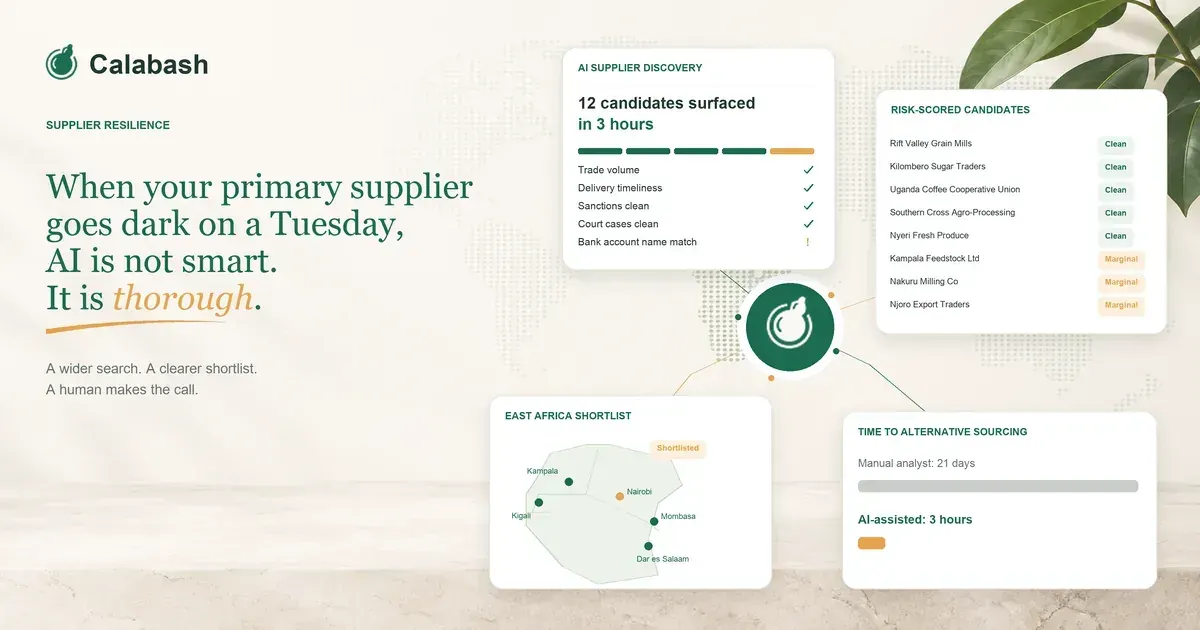
When your primary supplier goes dark on a Tuesday, AI is not smart. It is thorough.
A composite CPO's primary supplier goes dark on a Tuesday. By Thursday, an AI discovery tool has vetted twelve candidates using checks no rushed analyst could run by hand. The catch: none of it works if your own supplier records are a mess.
The CPO I am describing here is a composite drawn from conversations with procurement leads at Nigerian mid-market manufacturers. She is not one real person. The beats below are the ones that came up more than once.
Her primary supplier went dark on a Tuesday morning. Third missed delivery in a row. WhatsApp status "last seen 3 days ago." Emails bouncing back. The contact she had on file was on a personal Gmail address, not a company domain, which turned out to matter later.
The shape of her operation, for context. Roughly 200 people, roughly 800 active suppliers, Oracle NetSuite for the finance side, an ERP procurement module that most of her team routes around, plenty of email and WhatsApp with suppliers when the real work happens. The input that went dark was a specific agri commodity concentrate, single-sourced, because switching costs had always been "too high to bother with." Production runs two weeks of buffer stock on it. Not more.
By late Tuesday afternoon she gave her procurement analyst the ask, in seven words. Find me five vetted alternatives by Friday.
What the analyst had by end of that first day
I have watched this next scene enough times to describe it from memory. The analyst opens LinkedIn, the Corporate Affairs Commission search portal, a couple of trade directories, and Google. Twenty tabs by lunchtime. Three plausible names by end of the afternoon. She could not tell whether any of the three had ever supplied at the volume the plant needed, and she had no pricing to compare against the primary supplier's last invoice.
That is not a failure of the analyst. That is what a human procurement analyst can produce in eight hours when the ask is "five vetted alternatives" and the pool is the whole regional supply base for a specialised input. Discovery is fast, vetting is slow, and the second one is where the actual job lives.
What the AI did on Wednesday
Wednesday morning she opened a purpose-built AI supplier discovery tool (tools in this category include Tealbook and Scoutbee, among others). Not ChatGPT with a "find me suppliers" prompt. A tool designed to pull public trade data, shipping manifests, sanctions lists, court records, local trade registries, LinkedIn activity signals, and her own historical supplier records into a single query. She fed it the input specification, the volume envelope she needed to cover, the delivery corridor, and the last invoice price the primary supplier had quoted.
By Wednesday afternoon the tool returned 12 candidates. Each one carried a risk score, and the score was not one number. It was a stack of signals sitting next to each other, which is the part that matters.
The stack, more or less:
- Trade volume history for the input over the last three years
- Delivery timeliness inferred from shipping manifests
- Sanctions list check clean
- Court records check, including recent co-defendant appearances
- Local incorporation confirmed against the national registry
- Tax ID resolves to the same registered entity
- Recent LinkedIn activity from named counterparties inside the firm
- Bank account name on file resolves to the incorporated entity, not to a personal name
Two of the 12 had flags. Recent court case as a co-defendant on one, delivery timeliness below the sector median on the other. Five were clean across every signal. Five sat in the middle, marginal on one or two lines.
Thursday morning her analyst called the five clean candidates. Three responded. One quoted within 20% of the primary supplier's last invoice. She released a trial order that afternoon. The full production halt never happened.
The AI was not smart. It was thorough.
Here is the part I keep saying out loud until people stop nodding and start hearing it. What the tool did on Wednesday was not intelligence. It was patience, executed in parallel. Twelve boring public signals, checked against 12 candidates at the same time, which no human procurement analyst in a rush would ever check for every candidate on a shortlist.
Three weeks of due diligence, compressed into three hours. That is the whole trick. There is no cleverness underneath it.
I keep going back to this because the marketing around the category makes it sound like a magic detector, and when you sit inside a procurement team under pressure you start to expect a magic answer. What actually happens is the tool goes and gets the same things you would have gotten if you had a week and a very stubborn analyst. It just does not need the week.
The harder truth sits upstream of the AI
Now the awkward part. The ceiling on any supplier-side AI is the quality of your own supplier master data. If your existing record has duplicate rows for the same company, missing bank details, no country of incorporation, no tax ID, and half the contacts are on personal Gmail addresses, then the risk score the tool puts on your existing suppliers is worthless.
That matters because the whole value of a discovery tool is comparative. It is telling you a new candidate looks better or worse than something. If your baseline is broken, the comparison is theatre. You cannot rate a new supplier against a benchmark you do not actually have.
She got lucky in one specific way. The tool's read on her existing supplier network was worthless, because her internal master data was a mess. Its read on the new candidates was fine, because it was building them from scratch off public sources. The task in front of her needed the second reading, not the first. Next time it might not.
Fix your supplier master before you buy the AI. Deduplicate the rows. Get country of incorporation and a tax ID on every active supplier. Move every contact off personal email onto a company domain, or at minimum flag the ones that are not. Reconcile the bank account name to the incorporated entity.
It is unglamorous work. It is also what unlocks every AI tool that will land in this category for the next five years, because every one of them will compare a candidate against your standing record, and that record is either useful or it is not.
If you are the one who has to make this case internally, the pitch is short. Discovery is fast, vetting is slow, and AI collapses the second into the first only when the standing data underneath it is clean.
Sign up at calabash.app and we will walk through your supplier master with you before you spend a cent on the discovery tool that will sit on top of it.