South Africa already has the 30-day cap the EU could never pass. Here is what it is worth.
The EU fought for years over a mandatory 30-day payment cap and abandoned it. South Africa already has one. So does Nigeria on paper. The rule is not the gap; the enforcement is. While invoices age for months, the fraud window stays wide open.
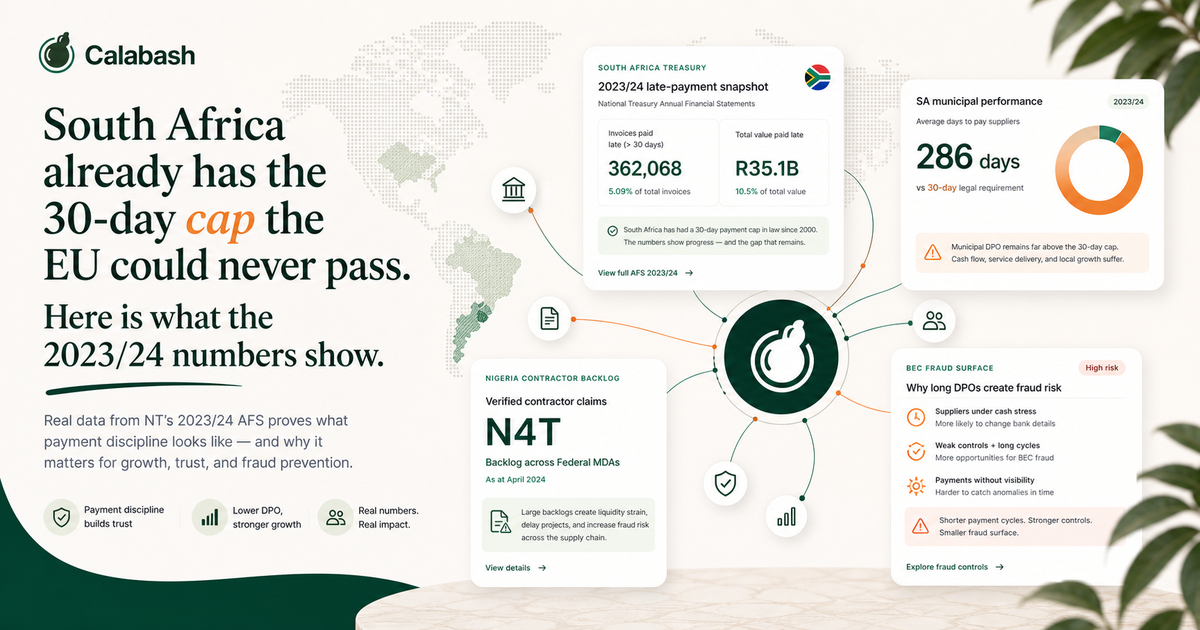
Three hundred and sixty-two thousand and sixty-eight invoices. That is the count of supplier invoices South African government departments paid late in the 2023/24 financial year. The value sits at R35.1 billion. At the end of March 2024, R10.7 billion of that was still unpaid past the 30-day window, sitting across 114,908 separate invoices, with provincial departments holding almost the entire stack.
That is the number the South African Government News Agency published on 1 July 2024. It is not in dispute. National Treasury reports the figure against its own compliance regulation.
The regulation is Treasury Regulation 8.2.3. It mandates 30-day payment by every national and provincial department under the PFMA. It has been the law for two decades. The European Commission spent eighteen months in 2023 and 2024 trying to legislate the same thing across the single market, watched the buyer lobby talk it down to 60 days, then watched the file get quietly retired by the incoming Danish Council Presidency. The EU debated it. South Africa already has it.
The interesting thing is not whether the cap exists. It is what the cap does when it does exist.
What 286 days looks like
In May 2025 the Auditor-General, Tsakani Maluleke, released the municipal audit picture for 2023/24. Across 275 municipalities, 41 produced clean audits. That is 15%. The same period showed municipalities averaging 286 days to settle supplier invoices. One hundred and seventeen of them, almost half the count, failed the 30-day requirement outright. Since the 2022 financial year, the same municipalities have absorbed R14.58 billion in interest and penalties as a consequence.
Two hundred and eighty-six days. The invoice gets approved, enters the ageing report, and sits there for nine and a half months before money moves. The legal requirement is thirty days. The actual time-to-cash is roughly ten times that.
By Q2 of the current financial year the picture had not improved. National Treasury's own compliance data, cited in the practitioner press through March and April 2026, showed 95,399 invoices older than 30 days unpaid, valued at R12.4 billion. That is a 17% regression from Q1. Provincial governments account for 97% of the overdue volume. Eastern Cape alone is sitting on R4.5 billion. Gauteng, R2.7 billion. Forty-eight percent of national departments did not file their monthly payment exception reports on time during 2024/25. The exception report is the mechanism by which Treasury monitors compliance. Half the buyers no longer file the form.
The SMME-facing fintech Sourcefin, which publishes invoice discounting against government receivables, puts the practical wait at 60 to 120 days. That is the survivable end of the distribution. The 286-day end is where companies go under.
The Nigeria version of the same picture
The Nigerian variant is more concentrated and noisier. In September 2025 the All Indigenous Contractors Association of Nigeria, representing roughly 5,000 member companies, said the Federal Government owed them around N4 trillion for 2024 capital projects already completed. Their secretary Babatunde Seun put it on the record at the protest: "All our jobs have been done, completed. Handed over with a certificate that we have finished the job." Out of 5,000 member firms, five had been paid. The Finance Minister had promised 48-hour settlement. The 2026 Appropriation Bill earmarked N100 billion against the N4 trillion claim. Two and a half percent.
The contractors hold the completion certificates. The certificate is the document that triggers payment under their contract. The payment never arrives.
Senator Sani Musa, chairing the Senate Committee on Finance, has been pushing through a direct-payment workaround. The diagnosis he keeps repeating is that the envelope-based budgeting system has failed and needs to be replaced by a priority-based model. Whether or not that is the right policy reading, it is the same problem the South African data describes from a different angle. The cap exists. The disbursement does not.
What the EU lobby actually told us about Africa
When I drafted the EU piece earlier this spring I treated the abandoned 30-day regulation as a confirmation that buyers will defend extended payment terms as a working capital instrument. They will. The 75-day invoice on a European treasurer's desk is a financing line dressed as a payable. The buyer lobby that killed the Commission proposal was honest about that, in writing, with their member states' votes.
I want to admit the thing I missed at the time. I read the EU outcome as the unusual case. I now think it is the easy one. A 75-day DPO is a policy choice a European buyer is defending against a regulator who is gently asking them not to. A 286-day municipal DPO is not a policy choice. It is the absence of any working system at all. Treasury Regulation 8.2.3 is not being lobbied against. It is being ignored, line by line, invoice by invoice, by buyers who are not refusing to pay so much as failing to operate the payment function in any meaningful sense. The lever the European treasurer is holding deliberately is the same lever a South African municipal CFO has dropped on the floor.
That distinction matters because it changes what the cap is worth. In Europe, the cap is the policy fight. In South Africa, the cap exists, has existed since the PFMA, and the data published by National Treasury against its own regulation tells you that legislation without an enforcement function changes very little. The Public Procurement Act 28 of 2024 that the President signed in July 2024 has not been proclaimed in force, and even when it is it will not materially change the 30-day rule, which lives in Treasury Regulation 8.2.3 either way. The rule is not the gap.
Where this lands for the AP control stack
The original turn of the EU piece was about the fraud window. A long outstanding invoice is two things at once. From the buyer's treasury seat it is a financing instrument. From the fraud seat it is a target. The longer the invoice lives, the more time a vendor email compromise actor has to study the supplier's normal pattern, observe the AP contact's rhythm, and push a bank account change while the context is stale.
The European version of that argument was about a 75-day window. The African version is an order of magnitude larger.
A municipal invoice sitting unpaid for 286 days is an invoice whose original supplier email, signature block, PO references and AP contact thread have been observable for nearly ten months. Interpol's African Cyberthreat Assessment names BEC as one of the top four cyber threats facing the continent. South Africa loses roughly R2.2 billion a year to cybercrime, with BEC accounting for around 40% of reported incidents. Operation Serengeti in 2024 linked to nearly $193 million in losses across 35,000 victims. The attack surface is not theoretical.
A 75-day invoice gives an attacker two and a half months to engineer a bank account change request. A 286-day invoice gives them nine and a half. The Nigerian contractor with a completion certificate from 2024 still waiting in mid-2025 has been observable to an attacker for over a year. None of those invoices needed to be on a long ageing report. The regulation says they should not be. They are, and the fraud surface that opens up next to them is one of the few mitigations no policy fix is going to close.
The mitigation is at the data model. The treasury-vetted bank account record sits in a different table from the supplier-provided one. The supplier-provided record is information. The treasury-vetted record is authorisation. They are not the same row, and they should never be the same row. The longer your ageing, the more important that separation becomes. The EU buyer kept the working capital lever and kept the fraud surface. The South African buyer never had the lever, has the surface anyway, and a regulation on paper that says none of this is supposed to be happening.
If you are running AP or treasury into the South African public sector, or you are a Nigerian contractor still waiting on 2024 work, sign up at calabash.app and we will walk through what the dual-record check would do against the invoices you have currently sitting past 60 days. Bring one of the long-tail records. We will tell you where the verification step would have closed the window, and where it would not have helped.