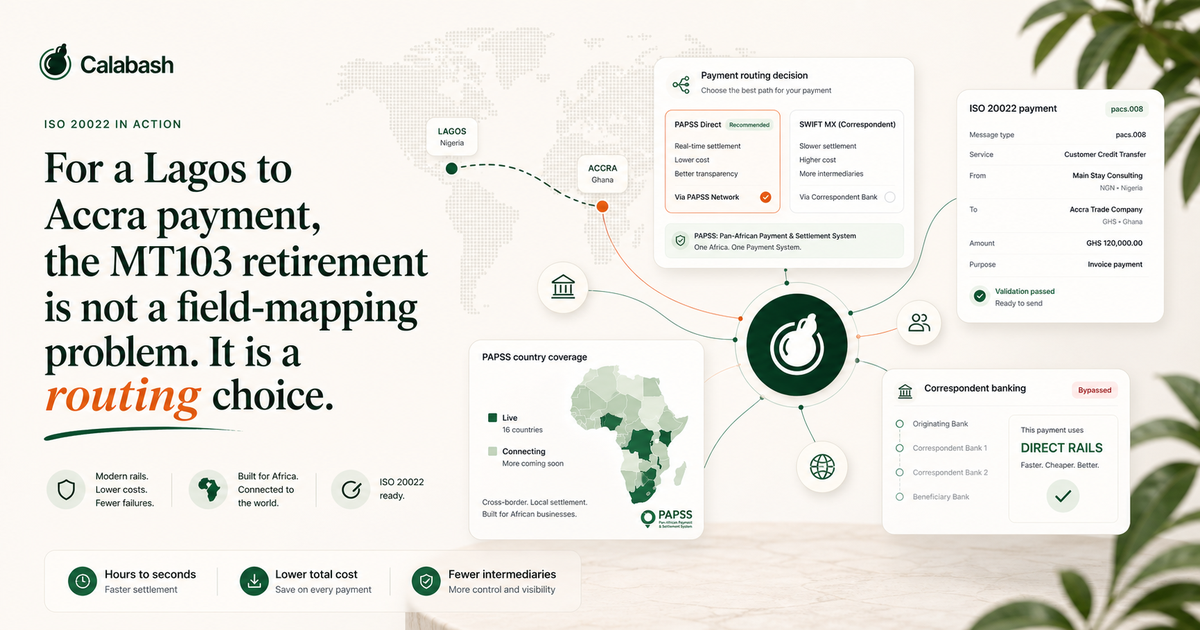
For a Lagos to Accra payment, the MT103 retirement is not a field-mapping problem. It is a routing question.
November 2025 ended the MT103 era. For a Lagos-to-Accra payment, the question is not whether your ERP can handle pacs.008. It is whether you need SWIFT at all. PAPSS was built ISO 20022-native from launch. The routing choice is now a strategic one, and most African treasurers have not made it yet.
Twenty-two banks. That is the number of Nigerian institutions now live on PAPSS as of Q1 2026, according to the company's head of marketing and communications speaking to TechCabal in March. Access Bank, UBA, Zenith Bank, First Bank, Fidelity Bank, Sterling Bank. The list reads like a sweep of the tier one and tier two banks any West African corporate treasurer would actually use to move money.
That fact changed the way I read the November 22, 2025 SWIFT cutover.
If you have been following the finance press, the story is familiar. SWIFT pulled the plug on MT103 and MT202 for cross-border instructions on that Saturday. The coexistence period for CBPR+ ended. From that day forward every cross-border instruction has to be in pacs.008 or pacs.009 format, ISO 20022 native, or the network can NAK it back. And the deeper deadline sits twelve months out. November 2026 is when SWIFT's grace period on unstructured addresses closes. After that, any pacs.008 with a free-text postal address gets rejected. As of March 2026, around 65% of CBPR+ messages still carry unstructured addresses and 44% of banks are not on track to meet the deadline.
That is the global story. It is the story most ISO 20022 commentary keeps telling. Banks scrambling. ERPs not ready. Address data in the wrong shape. AP clerks typing town names that the schema does not recognise.
It is the wrong story for an African treasurer paying inside Africa.
What I missed when I wrote about this last month
I wrote about the November cutover from a UK and European mid-market angle a few weeks ago. The post argued that the format change had shifted the burden of data quality onto the corporate, because the bank can absorb the network translation but cannot enrich an address that the ERP never sent. That is true for a London to Frankfurt payment. It is true for a Birmingham to Vietnam payment. I stand by it for those flows.
What I underweighted, reading the African press the morning the post went out, was that for a payment from Lagos to Accra the entire framing assumes a route through correspondent banking that the African treasurer does not have to take.
PAPSS was built ISO 20022 native from launch in 2022. The system's own documentation states that notifications are carried via the ISO 20022 messaging standard, notifying PAPSS, the participants and the RTGS of the status of every stage of the transaction. There is no MT103 to retire because MT103 was never in the loop. There is no coexistence period to end because the rails never ran on the old format. The November 22, 2025 cutover that broke the legacy MT chain inside SWIFT is, for an intra-Africa PAPSS payment, a thing that happened to a different network.
By Q1 2026 the network had grown to 19 countries, more than 160 commercial banks, and 15-plus national switches connected. The Onafriq and PAPSS bi-directional naira-to-cedis wallet pilot launched in February. Algeria joined in August 2025. Morocco's Bank Al-Maghrib came in the previous July. The build is real.
What the CBN deadline actually did
The CBN circular PSS/DIR/PUB/CIR/001/001 in late August 2025 set an October 31, 2025 deadline for all Nigerian deposit money banks, microfinance banks, mobile money operators, switching companies and PSPs to complete ISO 20022 migration. Compliance validation began on October 20. The circular language was direct: all payment transaction messages exchanged domestically or internationally must be formatted in ISO 20022 in line with CBN and SWIFT specifications.
I want to be careful here, because the circular covers bank-level compliance and there is no post-October 2025 public confirmation that NIBSS completed full ISO 20022 migration of its RTGS. The bank-side mandate is real. The system-side go-live, I cannot point to a public announcement. What I can point to is the timing. CBN bracketed the SWIFT cutover. The Nigerian deadline came three weeks before the SWIFT MT sunset. The structured-address grace period closes a year after the SWIFT MT sunset. The migration window for a Nigerian bank is not really a window anymore. It is the present tense.
South Africa got there first, in September 2022, when SAMOS went live on ISO 20022 over the weekend of 17 to 19 September. Kenya's KEPSS followed on 14 October 2024. ClearingPost described KEPSS as among the earliest adopters on the continent. The two-speed story the trade press likes to tell, where Africa is behind on payments modernisation, does not survive a careful look at the dates. South Africa was first in Africa. Kenya was three years ahead of the SWIFT MX hard cutover. Nigeria is inside the same twelve-month window as the European and US banks that are also still working through it.
Where the routing choice actually sits
Here is the part I had to think about, because the implication is not the one I expected.
For an African treasurer paying a Lagos supplier from an Accra account, or a Nairobi supplier from a Lagos account, the November 2025 SWIFT deadline is not a test of ERP fields. It is a test of routing choice. If the payment goes through PAPSS, the question of whether the originator address is structured or unstructured does not arise in the way SWIFT commentary frames it. The MT to MX cutover happened on a network the payment never touches. The November 2026 structured-address deadline is a problem for the SWIFT correspondent chain. PAPSS rides on a different message standard from day one.
If the payment goes through correspondent banking, by contrast, the African treasurer is in exactly the same position as the London or New York treasurer. The pacs.008 schema expects street name, building number, post code, town name, country code. The grace period closes November 2026. The bank cannot enrich what the ERP never sent. The AP clerk has to know which character set and which length limit applies. All of the global ISO 20022 readiness work has to happen, against the same deadline.
So the question is not whether the ERP is ready. It is whether the payment needs to use SWIFT at all.
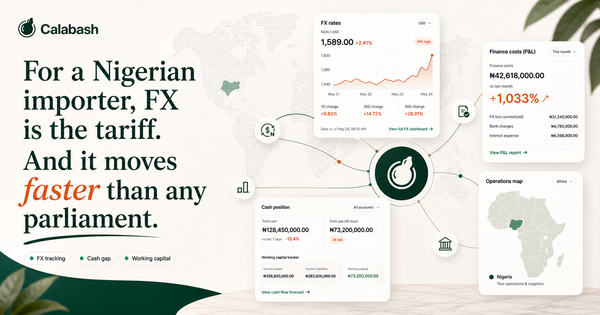
For an intra-Africa flow, that increasingly is a real question. The Chartered Institute of Bankers of Nigeria has been cited as estimating that intra-African reliance on external intermediaries in Europe or the US costs the continent around $5 billion a year in fees and delays — though I could not chase that figure back to the original CIBN publication, so treat it as directional rather than audited. What I can stand behind is that more than 80% of cross-border African payments are currently routed through correspondent banks in the US or Europe, and that average remittance cost in Sub-Saharan Africa was 8.45% in Q1 2025 against a UN SDG target of 3%. The routing default is correspondent banking. The ISO 20022-native alternative now exists for 19 countries.
What I would actually do this quarter
If I were a corporate treasurer in Lagos, Accra, Nairobi or Johannesburg paying suppliers across two or three African corridors, the work I would want done before the end of this quarter splits in two.
For intra-Africa flows, the question is which of my top supplier banks are already live on PAPSS, and what my own bank's PAPSS integration looks like at the corporate channel. The retail-facing PAPSS pages from Access Bank in Nigeria and FBN Bank in Ghana confirm the rail exists at the consumer level. The corporate channel is the part to verify with your relationship manager. If a PAPSS route is available for a corridor I currently run through London, the case for switching it is not just cost. It is also that the November 2026 structured-address problem ceases to apply to that flow.
For extra-Africa flows, the work is the same as it is everywhere else. The pacs.008 schema does not care that you are an African treasurer. The structured address grace period closes November 2026 regardless. The supplier master data has to carry the fields the schema expects. The AP clerk typing free text into a single address line is now writing future rejections.
The clean way to think about it, the way I would phrase it for a CFO who has fifteen minutes for this conversation, is that for intra-Africa flows you are picking a rail and for extra-Africa flows you are still on SWIFT MX. Those are two different problems with two different answer sets, and conflating them is what produces the wrong roadmap.
If you are running intra-Africa supplier payments and you want to look at what the supplier master needs to hold for both rails at once, sign up at calabash.app. We are building the buyer-side supplier record so it carries PAPSS participant fields and pacs.008 structured fields on the same business partner, with the routing decision sitting downstream of the data, rather than the other way round. Bring a sample export of your top thirty African suppliers and we will walk through which payments would clear cleanly on which rail today.