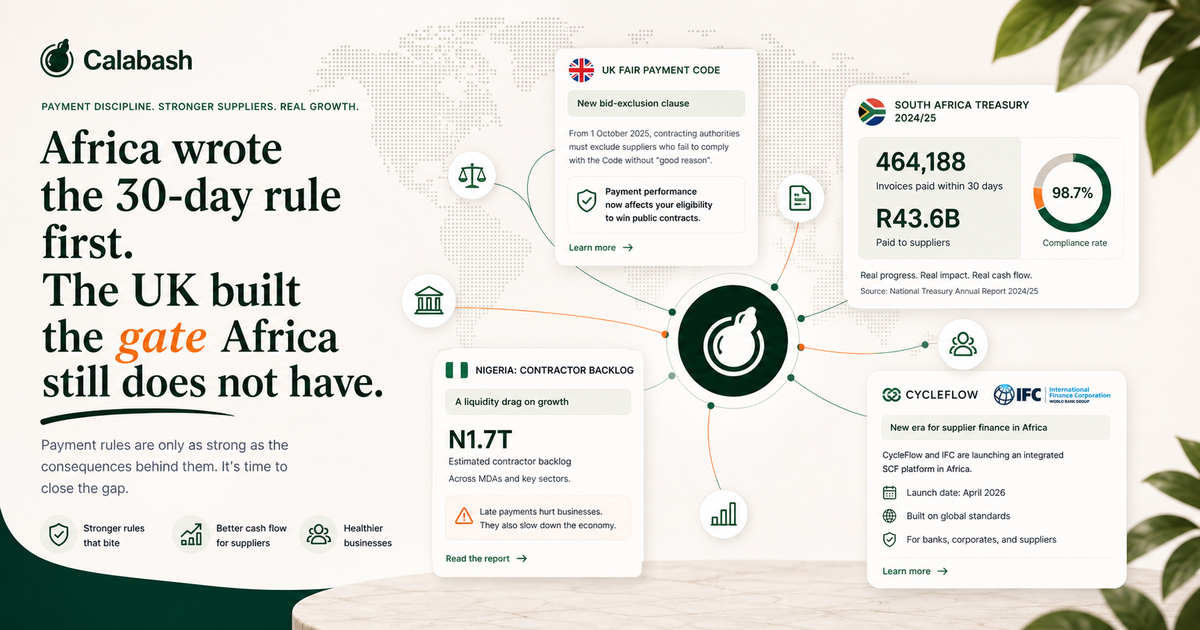
Africa wrote the 30-day rule first. The UK built the gate Africa still does not have.
Africa has the statute. South Africa's Treasury Regulation 8.2.3 has mandated 30-day supplier payments since 2005. Nigeria's BPP exists to enforce procurement discipline. Kenya's PPADA sets payment obligations. None of them have the gate the UK just built: a clause that says late payers cannot bid.
The line that changes things is in the Companies House blog post from January 2025, three paragraphs down.
"From 1 October 2025, any company bidding for government contracts over £5 million per annum will be excluded from the procurement process if they do not pay their own suppliers within an average of 45 days."
Read that twice. The Fair Payment Code itself is interesting. Three tiers, gold for 95% of invoices paid within 30 days, silver for 95% within 60 days including a 30-day floor for SME suppliers, bronze for 95% within 60 days. A reasonable scheme, voluntary, with a Small Business Commissioner signing the certificates. None of that is what matters.
What matters is the 45-day exclusion. For the first time in UK procurement, how slowly a buyer pays its own suppliers is not a reputational story or a CSR slide. It is a bid qualification criterion. You are in or you are out, on a number that comes out of your own ledger.
The Prompt Payment Code, which the FPC replaced in late 2024, had been around since 2008 and had collected over 5,000 signatories. It never had teeth. Companies signed it, fell out of compliance, were quietly delisted, and most of their customers never noticed. The Code was a noticeboard. The October 2025 clause is a gate.
What it is actually measuring
Average days payable outstanding, by your own books. Aggregated across the supplier base. Reported on demand to a procurement officer running a bid evaluation. If you cannot produce the number, you are not bidding. If you produce it and it is over 45, you are out of the evaluation.
The procurement officer does not have to believe the number is malicious. They do not have to find a victim. The clause is mechanical. Above 45 on average, exclude.
I want to dwell on the word average because it is doing work. A company can pay 70% of its invoices in 30 days and 30% in 90 days and run an average around 48. Optically the company looks like a prompt payer.
Most of its suppliers feel paid on time. The aggregate runs them out of contention. The shape of the distribution matters less than the mean, and the mean is calculated against what is in the system, not against what the AP lead thinks is happening.
The companies I have talked to in the last three months who are exposed to this clause mostly do not know whether they would clear it. They have a guess. The CFO usually estimates somewhere in the high thirties. The AP lead, when pressed, gives a range that overlaps with the high forties. Neither has a clean number.
The procurement officer can ask
That is the change. Up to last October, no buyer at any level had standing to ask the question. Now any procurement team at any government body bidding the wrong side of £5 million can ask it as part of their pre-qualification questionnaire. They will start asking, because they are now liable for the answer. A procurement officer who awards a contract to a bidder who turns out to have been above 45 has a personal problem.
What the bidder produces in response is going to be one of two things. The first is a clean audit-trail report out of the AP system, signed by the financial controller, with a methodology note that the procurement officer can replicate against the supporting data. The second is a panicked spreadsheet pulled together in a week, with a mixture of invoice-receipt dates and invoice-issue dates and disputed-invoice exclusions that nobody can agree on, that nobody is going to sign.
The first one wins the bid. The second one is the one most mid-market companies are currently structurally capable of producing.
The personal admission
When the Fair Payment Code came out I read it as a reputational document. A nice scheme. Worth mentioning in a sustainability report. I did not think it would change buying behaviour at the mid-market level. The October 2025 enforcement clause was buried in the same announcement and I missed it on the first pass, the same way most people I have spoken to about it missed it.
I went back to the Travers Smith write-up in March of this year because a treasurer at a UK manufacturer pushed back on something I said about payment terms being a buyer's free lever. She told me about the clause.
She told me her CFO had spent two weeks getting the company's actual average DPO out of the ERP and that the answer had come in at 51. They were a regular bidder on framework contracts in the right size range. They had a problem.
What I had wrong was the assumption that voluntary codes stay voluntary. This one did not. It got an enforcement attached after the fact, and the enforcement was attached at the only point in the system where buyers actually pay attention, which is procurement.
The treasury and AP problem this surfaces
You cannot manage a number you cannot see. Most mid-market AP systems will give you days payable outstanding as a quarterly metric pulled from the general ledger. That is not the operational number the FPC cares about. The FPC cares about days from invoice receipt to payment, by supplier, segmented by supplier size, across a rolling window the procurement officer will define when they ask for it.
The companies that can produce that data on demand will pass the bar quickly even if their average sits above 45, because they can also show the work needed to bring it down. The companies that cannot produce the data will fail before they get to a remediation conversation.
The remediation conversation, by the way, is the interesting one. Once a treasurer can see payment timing by supplier, the next question is which exception categories are eating the days. Invoice approval lag is usually the biggest one. Disputed invoices that sit in a queue without a clock on them.
PO-mismatch exceptions that bounce around between AP and procurement for a fortnight. Bank-account verification holds that take three weeks because nobody owns the callback. Each of those is a process bucket with its own median time-to-resolution, and the work of getting average DPO under 45 is mostly the work of compressing the long tail of each bucket.
That is treasury work and AP work happening together on the same data. It does not happen at all if the data does not exist.
The bar got real
The £5 million government-contract threshold catches a lot more companies than the policy summary suggests. Any mid-market services firm bidding on local authority work, any construction outfit on framework contracts, any IT services group on the digital-marketplace runs. The qualifying threshold is contract value, not company size. A £40 million revenue services business that bids one large public sector contract a year is now operating under a metric the AP function was never designed to track.
If you are running treasury or AP at a UK mid-market business with any public-sector revenue and you do not yet have payment timing by supplier as a number you can produce on demand, sign up at calabash.app/b2b and we will walk through what we have built against the workflow you have today.
Bring a recent month of AP activity. We will tell you what the FPC report would look like coming out of it and which buckets are likely eating your average.