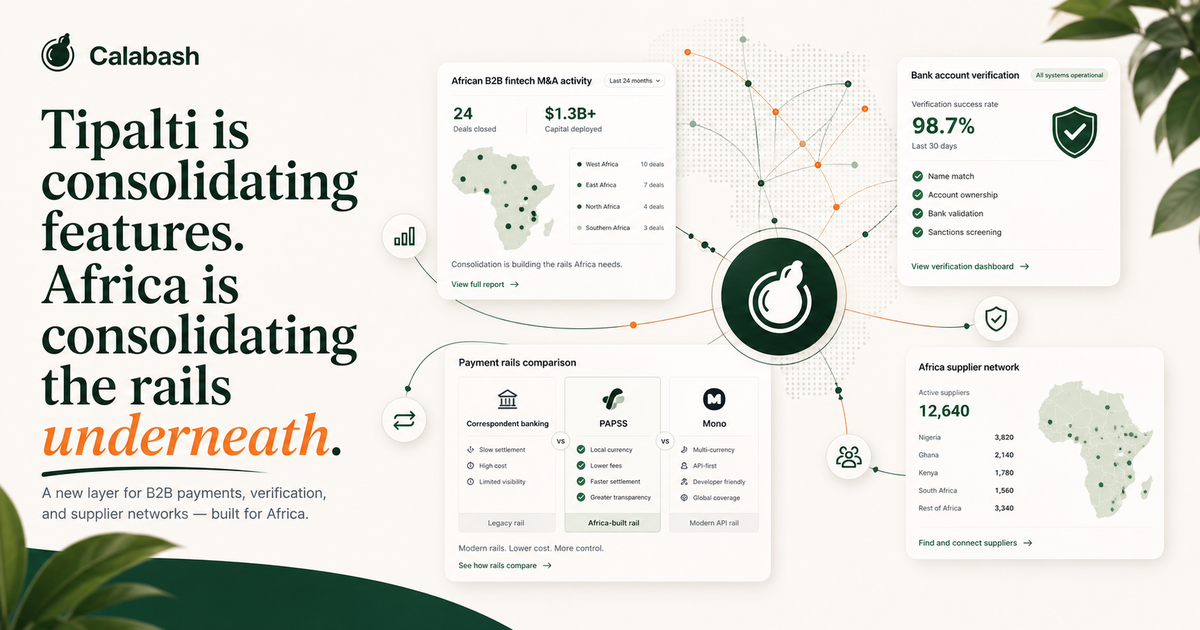
Tipalti is consolidating features. Africa is consolidating the rails underneath.
Tipalti just raised $200M on $200M ARR. In Nigeria, the nearest equivalent is still fighting to get a bank account on an invoice verified before the payment runs. The consolidation story looks completely different from this side of the continent.
Tipalti's press release on September 24, 2025 led with $200 million in growth debt from Hercules Capital, $200 million in ARR, $75 billion in annualised payment volume, and a customer base north of 5,000. I read it the morning it dropped. Then I read the Techcabal piece on dLocal closing its $23.7M asset deal for AZA Finance in February. Then the TechCrunch note from January on Flutterwave buying Mono in an all-stock deal worth somewhere between $25M and $40M. I have been turning the three numbers over together ever since.
If you read the US trade press, the story is mature-market consolidation. Mid-market AP automation is collapsing into a small number of well-capitalised platforms, of which Tipalti is the clearest current exhibit. Bill is another. Stampli, Airbase before Brex absorbed it, Coupa for the larger end. The capital is going to the survivors. The features the next wave of buyers will treat as table stakes by 2027 will be shipped by the platforms with the balance sheet to ship them.
If you read the African trade press in the same months, the story looks superficially similar. Techcabal counted 67 African startup M&A deals in 2025, up from 39 the year before. Fintech led with 31 of them. The framing they used was, “The new question is no longer who can raise next, but who can survive, consolidate, and compound advantage under tighter conditions.”
Those two stories are not the same story. They look like the same story. They are not.
What is actually being bought
The US deals are feature consolidation. A platform buys a competitor or absorbs a category to add invoice capture, or expense management, or a corporate card layer, or an AI agent for tax form scanning. The thing being acquired is a workflow capability that sits on top of payment rails everyone already takes for granted. ACH works. Bank accounts are verifiable in milliseconds against a US clearing-house file. KYC has decades of history behind it. The infrastructure underneath the AP automation product is invisible because it is reliable.
The African deals are a different category of move. dLocal did not buy AZA Finance for a richer AP workflow. They bought what was left of a cross-border B2B payments rail across 35 markets, for $23.7M, in an asset sale, after AZA had reportedly been valued at around $150M in its last 2024 round. dLocal’s own framing on the gap was diplomatic. “Regulatory complications prolonged the timeline to finalise the transaction, affecting AZA Finance’s topline growth during the process.” The polite reading is that infrastructure consolidation in Africa runs on a different clock than in the US, and the price reflects it. The less polite reading is that even the best-funded African cross-border rail with $57M of lifetime funding could not get to a clean exit, and the acquirer took the rails for cents on the dollar.
Flutterwave’s acquisition of Mono is the same category of move. Mono is not a workflow product. It is bank account linkage infrastructure across about 8M linked accounts, which Mono reports is roughly 12% of Nigeria’s banked population. Flutterwave now has account verification sitting under its payments stack across 34 countries. That is closer to what an African AP function actually needs than any US AP automation vendor has ever shipped on the continent.
Moniepoint sits at a different scale and a different layer, but it tells the same story. The October 2025 raise added $200M on top of the $110M Series C from a year earlier, against a 2025 processing volume of NGN 412 trillion (about $297B) and 14 billion transactions. Moniepoint is a merchant acquirer and SME banking platform, not an AP automation vendor. It is the infrastructure layer that a meaningful share of Nigerian B2B transactions actually run on. The capital is going into rails too.
That is the part I want to dwell on. The capital in the African B2B payments market is moving into the layer beneath invoice workflow. Account linkage. Cross-border rails. Merchant acquiring. Payment licences. Nobody on this continent is paying anything like a $200M ARR multiple for invoice-workflow software, because invoice workflow is not the binding constraint.
What I got wrong about this
For most of last year I described what we were building as an AP automation play for African mid-market and enterprise buyers. The framing was “we are doing what Tipalti and Bill do, for this market.” I borrowed the analogue because it was legible. CFOs in Lagos and Nairobi had heard of Tipalti. The pattern of conversation went, “so it is the African Tipalti.” And I would nod.
I stopped nodding around February. What I had missed was that the binding constraint for an African treasurer signing off on a supplier payment sits a layer below invoice workflow. The question that actually slows a payment is whether the bank account on the invoice is real, active, attributed to the supplier the buyer thinks it is attributed to, and reachable through a rail that will not silently fail because a correspondent bank in a third country has decided the structured originator address is missing a town name. I had been pitching against the wrong gap.
Duplo is the closest African AP automation analogue I can point at. They secured dual NRS licences (Systems Integrator plus Access Point Provider) in March 2026 ahead of Nigeria’s mandatory e-invoicing go-live in July. Their CEO Yele Oyekola framed the licence as, “This isn’t just about compliance; it’s about closing the loop.” The loop he is describing is e-invoicing plus payment, in the same platform, against an NRS mandate that will start enforcing in January 2027 with penalties at 100% of the VAT due on each non-compliant invoice plus interest at 2% above the CBN monetary policy rate. Duplo’s total funding is around $5.6M. There is no published revenue figure. No African AP or spend-management vendor has publicly disclosed revenue at anything like Tipalti’s scale, and I no longer think that absence reflects a missing winner. I think it reflects a market where invoice workflow is downstream of a more interesting problem.
Where the two-table model actually lives
Calabash’s data model keeps supplier-provided bank account records and treasury-vetted bank account records on separate tables with a verification gate between them. In a US context that gate is a defensive measure against vendor email compromise, where the risk is that a real supplier email arrives with a substituted IBAN. In an African context the gate is doing more work than that. It is also asking whether the account is reachable through a rail at all, whether the BVN attribution holds, whether the supplier business partner record on the buyer’s side maps cleanly onto whichever of the eight banks the supplier actually transacts through. The gate has the same shape on both continents. The questions it answers are heavier on this one.
I want to be clear about where we are. Calabash is pre-revenue. We have not yet sat across the table from a treasurer at a Nigerian manufacturer or a Kenyan logistics firm to walk through a supplier file end to end. What we have is a data model and a thesis. The thesis is that the AP automation conversation on this continent runs downstream of the rails consolidation happening this year and next, not parallel to it. When Flutterwave or Duplo or someone we have not heard of yet has the verification layer at infrastructure scale, the invoice-workflow product on top becomes interesting. Before that point a workflow product is selling against a gap the buyer does not feel yet.
The question worth asking this quarter
If you are running treasury or AP at a mid-market African business, the question worth asking this quarter has nothing to do with which AP automation platform to evaluate. The question is which bank accounts on your current AP file you can verify against an independent source in under a working day, and what your workflow does when one of them cannot be verified. In most of the conversations I have had, the answer to the second part is, “we pay it and we wait to see if it lands.” That is the gap the rails consolidation is going to close. The platforms doing the closing will be the ones whose names are in the M&A press this year.
Sign up at calabash.app and bring a sample of your last thirty cross-border supplier payments. We will work through which of them would have passed a two-table verification on our model and which would have stopped at the gate. We will also tell you, honestly, where Duplo or Flutterwave or Moniepoint already does enough of what you need that moving anything would be premature.