Kyriba built enterprise stablecoin rails this month. A survey four days later said the rail was never the problem.
Kyriba partnered with a regulated stablecoin provider for enterprise treasury on July 6. Four days later a survey found most mid-market firms still won't touch stablecoins, because the reconciliation and approval controls aren't ready. Nigeria shows why that gap matters most.
On July 6 Kyriba announced a partnership with Merge, a regulated stablecoin payment provider with dual regulatory authorisation and Bank of England safeguarding, to put stablecoin settlement inside its treasury platform. The scale behind that is not small. Kyriba moves something in the order of $51 trillion a year across 10,000 banks and 4,000 multinationals in 170 countries. The corridors named in the release were Brazil, India, and the United Kingdom. Bob Stark, who runs market strategy there, framed the whole thing in one line: "The question treasury teams are asking isn't whether stablecoins work: it's whether they can trust the infrastructure behind them."
Every trade outlet wrote it up as a rail story. Faster settlement, lower fees, a regulated dollar corridor bolted onto a serious TMS. It is a real milestone and the reporting was fair. That is not what I want to write about.
Four days later PYMNTS Intelligence published a survey that said, more or less, the opposite of the excitement. Around 40% of middle-market firms have discussed or tested stablecoins. Only 13% actually use them. The rail exists now, it is regulated, it settles, and five out of six of the companies that looked at it walked away anyway.
The obvious read is that they are being slow. I do not think that is it.
What the 27 points between 40 and 13 actually are
If four in ten firms have looked at stablecoins and only just over one in ten use them, the interesting number is the gap. Twenty-seven points of companies who did the work to evaluate this and then said no. PYMNTS was blunt about what sits in that gap, and none of it is the token. Their line: "Finance teams need stablecoin transactions to appear inside the same dashboards, reconciliation processes and accounting records that already support traditional payments."
Read that back slowly, because it is the whole post. A stablecoin payment has to land inside the same reconciliation, the same approval chain, the same sanctions screening, and the same audit trail as every other payment leaving the business. If it does not, the controller cannot close the month, the treasurer cannot sign off the controls, and the auditor has a finding. At that point the 3% corridor saving is worth nothing, because nobody will authorise a payment they cannot reconcile and evidence afterwards.
That is not a payments-rail problem. It is a back-office problem. And it is the exact layer we build, which is the reason I keep coming back to this one.
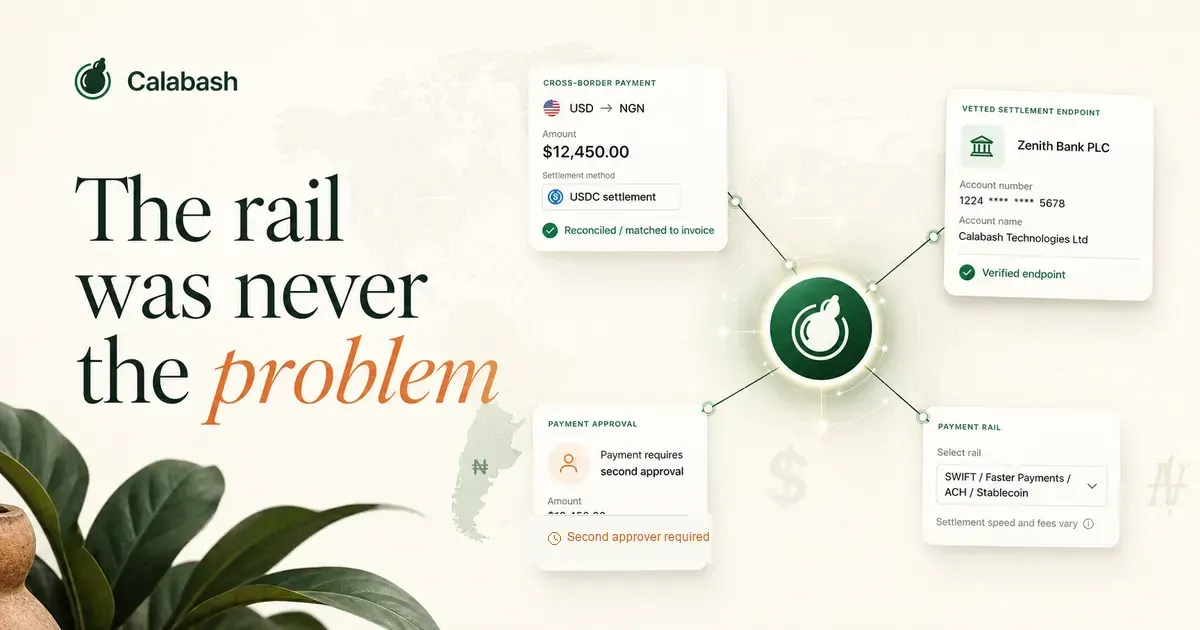
Here is the part I find almost funny. Calabash does not need to hold an opinion about what rail sits underneath a payment. SWIFT, Faster Payments, an ACH, a Bank of England-safeguarded stablecoin: the job on top is identical either way. There is a vetted bank account, or in the stablecoin case a vetted settlement endpoint. There is a workflow approval with a named second pair of eyes. There is a reconciliation tie-back against the invoice. The rail is a plumbing detail below all of that. Kyriba built the plumbing for the enterprise. The reason the mid-market survey came back at 13% is that most mid-market firms do not have the layer that would let them trust any new rail, stablecoin or otherwise.
The thing I was wrong about
For a long time I filed stablecoins under speculation and moved on. There is a Kansas City Fed finding, which I have only seen secondhand through the same PYMNTS reporting, that payment activity is less than 1% of all stablecoin usage. Almost everything is trading and settlement between crypto desks, not a company paying a supplier. So my working assumption was that this was not a treasury topic yet. It was a trading topic wearing a treasury costume.
Nigeria is what changed my mind.
Per the IMF, summarised via PYMNTS, Nigeria accounts for roughly 60% of stablecoin inflows into sub-Saharan Africa since 2019, taking in something close to $59 billion of incoming crypto-assets in the year to June 2024. The IMF's own framing is that when the coins are dollar-denominated, "widespread use can resemble a digital form of dollarization." The driver is not speculation. It is that the average cost of sending $200 into sub-Saharan Africa runs around 9% of the amount against a 6% global average, and the naira has been volatile enough that holding value in dollars for a week is a treasury decision, not a punt. Mbah Casmir, who runs a Nigerian fintech called Monica Cash, put it plainly in Disrupt Africa on July 1: "Stablecoins have become one of the tools helping businesses manage that risk... Much of the demand is being driven by utility rather than speculation."
So the global average hides the case that matters. The less-than-1% payment figure is true and also beside the point, because the payment usage is not evenly spread. It is concentrated exactly where a currency is under pressure and the correspondent-banking corridor is expensive. That is Nigeria. That is a lot of the markets a mid-market exporter or importer actually deals with.
And here is the sharp end of it. The country with the strongest real-world case for business stablecoin payments is the one corridor none of the big enterprise partnerships named. Kyriba and Merge listed Brazil, India, and the UK. Not Nigeria. Nigerian businesses are not waiting to be included. They are already settling in USDT on P2P desks today, at whatever scale you want to believe of the roughly $92 billion in crypto transactions Nigeria processed in 2024, per the same Disrupt Africa piece. Almost none of that runs behind a vetted-bank-account process, a second-eye approval, or a reconciliation tie-back. Which means the exact market with the most stablecoin payment activity is the market running it with the fewest controls. A fraud and reconciliation problem, hiding in plain sight, dressed up as an adoption success story.
I was wrong to file this under speculation. It is a controls gap, and it is widest precisely where the payments are most real.
What this means if you run treasury or AP
You do not need a position on stablecoins to take the lesson. The 13% number is not really about tokens. It is about whether a new payment rail can land inside a process you can already reconcile, approve, screen, and audit, the same question we laid out in how to evaluate a treasury platform, applied now to a rail nobody had priced in when we wrote it. If it can, the rail underneath is a footnote and you can adopt whatever settles cheapest into the corridor you need. If it cannot, no corridor discount will ever be worth the month-end you cannot close. The enterprise bought that layer from Kyriba this month. The mid-market mostly has not bought it from anyone, which is the actual reason the survey looks the way it does.
Sign up at calabash.app/b2b and bring the last cross-border payment that gave your team reconciliation grief, plus the supplier and the settlement endpoint it went to. We will walk through what our vetted-account, second-eye, tie-back workflow does with it, and where the controls would sit if that same supplier asked to be paid in a stablecoin next quarter. We will also tell you honestly where you do not have this problem yet, so you do not go chasing a rail you have no reason to touch.