Sasol is about to migrate twice while 85% of its supplier base cannot get on the network at all
Next-gen SAP Ariba is live and African enterprise procurement leads did not choose the timing. The rebuild coincides with ECC end-of-maintenance and lands on top of a supplier base that is 85-90% informal. Two migrations, one budget cycle, zero slack.
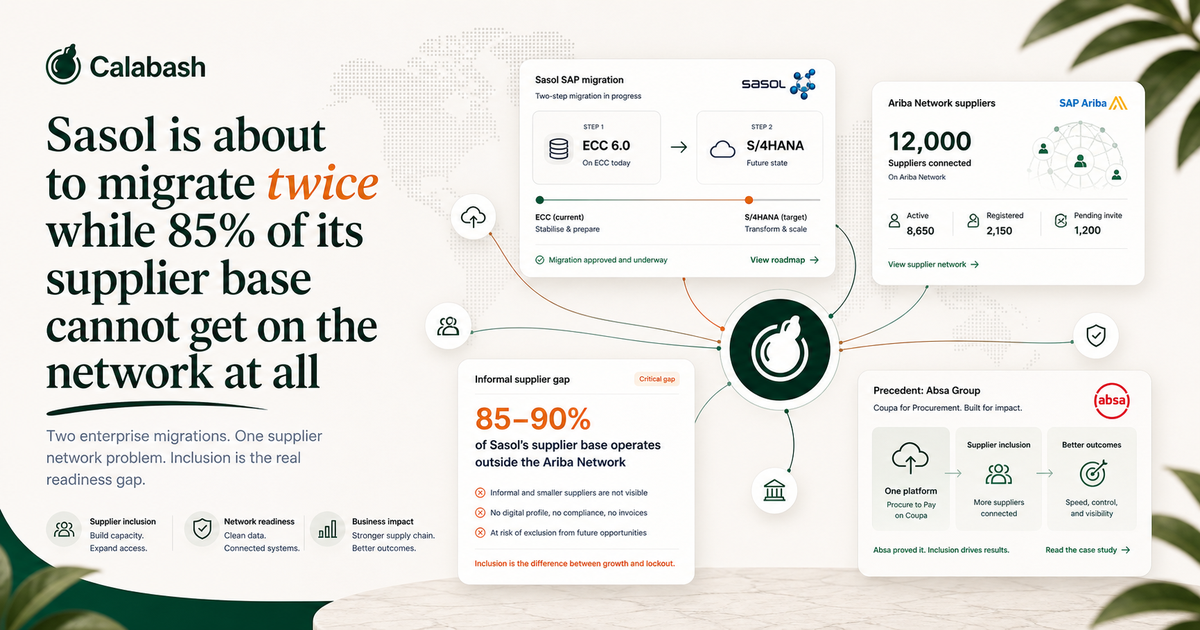
Seventy-five percent. That is the share of total procurement transactions Sasol processes through the SAP Ariba Network in the Southern Africa region, according to the case study SAP Africa published in February 2021. R50 billion in annual spend. About 12,000 global suppliers. A 50% reduction in accounts payable costs and a 95% on-time supplier payment rate. By the metric SAP wants you to use, that deployment is the African enterprise procurement showcase.
It is also the deployment that is about to take the hardest hit from SAP's next-gen Ariba rebuild, and not for the reason most of the procurement press is covering.
Here is the shape of the problem. Sasol's Ariba estate sits on top of SAP ECC. Mainstream maintenance on ECC ends 31 December 2027. At the end of 2024, only around 39% of SAP ECC customers had even licensed S/4HANA, which means more than 60% had not moved. African SAP estates skew to the wrong end of that distribution. So Sasol, MTN Nigeria, Coca-Cola Beverages South Africa, and every other African Ariba shop on the published customer list is staring down an ECC-to-S/4HANA migration that has to land inside the same 18-to-24 month window during which next-gen Ariba is being rolled out on BTP. Two enterprise migrations stacked on top of each other, both running through the same implementation partners, who will be at peak global demand the whole way through.
Premikati called the next-gen Ariba change "the most consequential architectural change in SAP Ariba in years." It is not a forced migration in the strictest sense. Customers can run legacy and next-gen in parallel until full feature parity, which SAP is targeting before the end of 2027. So the parallel-run window and the ECC end-of-maintenance window close in the same quarter. That is one supply of SAP integration capacity, divided across two sets of programmes that cannot be sequenced without the budget cycles colliding.
That is the first part. The second part is the part the SAP case study cannot help you with.
Sub-Saharan Africa runs on an 85-to-90% informal-or-semi-formal business base, according to Duplo's 2025 B2B payments guide. The Ariba Network was not designed against that distribution. Supplier fees start free up to five documents or roughly $50,000 of annual transaction volume per buyer, and then climb. A Lagos logistics SME billing one multinational $200,000 a year pays roughly $310 in transaction fees plus whatever subscription tier they fall into. For a 200-person KwaZulu-Natal engineering subcontractor, that is a cost on top of an onboarding process that already requires a level of documentation most of their tier-three and tier-four supply chain cannot produce.
Olumide Olusanya, CEO of Gloopro and organiser of the inaugural Digital Procurement Africa Summit in Lagos in May 2026, said the line out loud. "There is no meeting point between that informality compared to the standard platforms that most of our customers use." His clients include Unilever Africa, Uber Nigeria, and LaFarge. Those are the buyers. The gap he is naming is the one between an enterprise procurement mandate from a multinational HQ and the actual supplier ecosystem in Lagos, Joburg, or Nairobi that has to be paid against it.
The next-gen Ariba rebuild does not close that gap. Joule agents reasoning across a unified BTP data set require the data to exist in the first place. Olusanya again, on the record at the same summit. "AI cannot have any impact in an environment where you don't even have the data available." That is the constraint. You cannot run agentic procurement intelligence over a supplier base that mostly does not transact on a network because the network's onboarding economics exclude them.
The Absa precedent is the part of the story SAP is not advertising
The single most useful piece of public information out of African enterprise procurement in 2025 was the Absa case study SAP itself published in July. Project Owari put SAP S/4HANA across Zambia, Mauritius, Seychelles, Ghana, Tanzania, Botswana, Uganda, Kenya, and South Africa. Finance on SAP. Procurement on Coupa.
Not Ariba. Coupa.
Absa is Africa's second-largest bank by assets. It deliberately split the stack. Finance went onto the SAP rail because that is where the general ledger had to live. Procurement went to a separate vendor because, on the evidence, Coupa was the better fit for the spend-control and digitised-mandate problem they were actually trying to solve. African Bank followed in October 2025, signing as a new Coupa customer in Coupa's Q3 FY26 cohort. Two of the South African banking sector's serious procurement modernisations in eighteen months. Neither of them on Ariba.
That is not a small data point. That is the largest published African deployment of the year saying, in effect, that even an SAP-finance shop will go elsewhere for procurement when the choice is on the table. The implication for the next-gen Ariba rollout in Africa is that the buyer-side of the regional book is already softer than SAP's account team probably reads it.
What I had wrong
I went into this thinking the African Ariba customer was an inherited problem. A subsidiary of a global multinational running a tool the parent picked. Read off a roadmap nobody in Lagos or Joburg had a vote on.
That is partly true. The Sasol, MTN, and Coca-Cola Beverages South Africa estates are real deployments with real local teams operating them. What I underweighted was the second-order effect. While the local SAP team in those buyers spends the next two years absorbed in the ECC-to-S/4HANA and legacy-to-next-gen-Ariba programmes, the supplier-onboarding gap goes nowhere. The 85-to-90% of the supplier base that cannot economically join the Ariba Network this quarter cannot economically join it during the migration either. And the buyer-side procurement leads in Lagos and Joburg, who would normally be the ones pushing on the supplier-onboarding problem, are about to lose attention and budget to a platform change for the next 18-to-24 months.
The Absa precedent is the route a finance director in this market actually takes when the constraint becomes visible. Keep the SAP general ledger. Decouple procurement. Run the controls that close the spend-leakage gap on something built closer to the operating reality.
What that means for a treasurer in this market this quarter
If you are running AP or treasury at a Nigerian, Kenyan, or South African mid-market business and your multinational customers or suppliers are on SAP Ariba, the next two years of their procurement programme are not going to be about the supplier-onboarding gap with you. They will be about the rebuild. The window to harden your own controls before they impose a new set on you is roughly now. The same window applies if you are a non-SAP buyer with a tail of Ariba-resident counterparties whose AP cycle is about to get noisier as their internal migration runs.
The structural fix is the same one I have been writing about. Supplier bank accounts held in two parallel tables: a treasury-vetted record that payment runs against, and a profile record the supplier edits, with a workflow promotion step in between carrying named approvers and an audit trail. That control works whether the buyer-side platform is Ariba, Coupa, Gloopro, SAP S/4HANA, NetSuite, or a folder of PDFs. It is the workflow underneath the platform that determines whether the wire goes to the right account.
If you run AP or treasury at a mid-market buyer in Lagos, Nairobi, or Joburg and you want to compare the verified-record model against the workflow you have today, sign up at calabash.app. Bring a recent supplier bank account change request, ideally one you nearly missed. We will walk through what the verified-record check would have done with it, and where it would not have helped. The honest framing is the only framing that survives in this category.