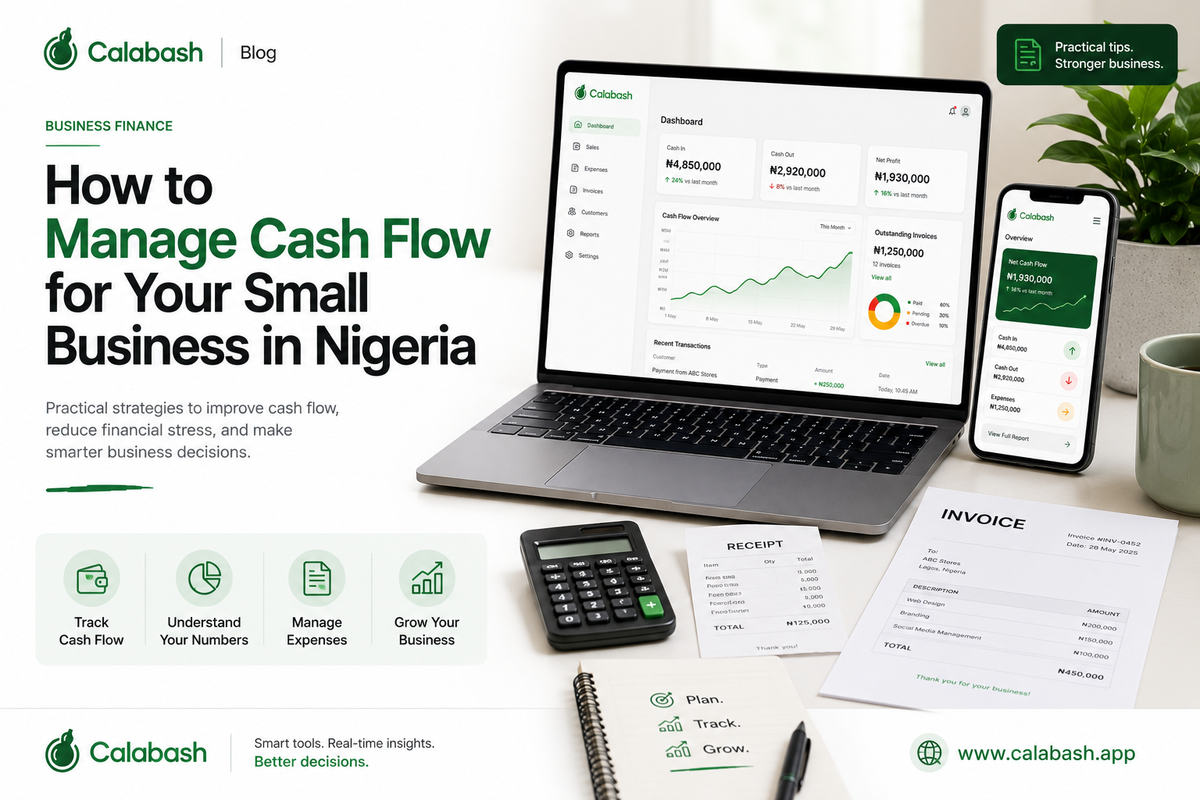
How to Manage Cash Flow for Your Small Business in Nigeria
Cash flow management is the process of monitoring, tracking, and optimizing the timing and amounts of money moving into and out of your business.
Kemi ran a boutique in Ikeja that everyone in the neighbourhood knew. Her racks were always stocked, her customers always returned, and on most days the shop was busy from morning until close. By every visible measure, Kemi's business was doing well.
But every month, without fail, something strange happened. The sales were there. The customers were there. The activity was constant. And yet at the end of each month, Kemi could never fully account for where the money had gone. Her bank balance told one story. Her gut told another. And somewhere in the middle, profit was disappearing.
Kemi is not unusual. Across Nigeria, hundreds of thousands of small business owners; retail shop owners, distributors, pharmacy operators, FMCG sellers, fashion wholesalers; experience exactly what she experienced. Busy businesses. Invisible losses. Unexplained gaps between revenue and cash.
The problem is not the business. The problem is the system or more accurately, the absence of one.
What Is Cash Flow and Why Does It Matter for Small Businesses?
Cash flow management is the process of monitoring, tracking, and optimizing the timing and amounts of money moving into and out of your business. At its most fundamental level, it answers one essential question: do you have enough money available right now to meet your obligations, pay your suppliers, and keep your operations running?
For small businesses in Nigeria, where the margin for financial error is often slim, interest rates on borrowing are high, and access to emergency credit is limited, effective cash flow management is not optional. It is the difference between a business that survives and one that does not.
There are three primary categories of cash flow every small business owner needs to understand:
• The money generated from your day-to-day business activities. Sales, payments from customers, supplier costs, staff salaries, and rent all fall here.
• Money spent on or earned from assets; equipment, property, or other long-term investments.
• Money that comes in from loans, investor funding, or goes out as loan repayments.
Most small business owners only think about the first category. But without a system that captures all three in real time, you are always working with an incomplete picture.
The Six Hidden Reasons Your Cash Flow Is Broken
Most small business cash flow problems do not start with one catastrophic event. They begin quietly; small leakages, overlooked patterns, and untracked movements that compound over weeks and months until the damage becomes obvious. Here are the most common culprits:
1. Unpaid Customer Invoices Sitting Untracked
When a customer buys on credit and you record the sale without following up on the payment, that revenue exists on paper but not in your account. For many Nigerian small businesses, accounts receivable, money owed by customers, is one of the biggest cash flow killers. Invoices get sent on WhatsApp and forgotten. Payment dates come and go with no follow-up. Over time, the cumulative amount outstanding becomes a serious drag on your business finances.
2. Inventory That Cannot Be Accounted For
Inventory shrinkage, stock that goes missing, gets damaged, or is sold without being properly recorded, is one of the most expensive and least visible problems in retail and trade businesses. Without real-time inventory management, you only discover discrepancies when it is too late. By then, money has already left the business.
3. Expenses Scattered Across Multiple Accounts and People
When business expenses are paid across personal accounts, business accounts, mobile money wallets, and cash, with no central record, tracking total spending becomes nearly impossible. Many small business owners underestimate their actual expenses by a significant margin simply because they cannot see all of them in one place.
4. No Separation Between Business and Personal Finances
This is one of the most common and most damaging habits among Nigerian SME owners. When personal spending and business spending flow through the same account, profitability becomes impossible to measure accurately. You cannot manage what you cannot clearly see.
5. Making Decisions Based on Bank Balance Instead of Business Data
Your bank balance tells you what is in your account right now. It does not tell you what is already committed to supplier payments this week, what customers still owe you, or whether your business was actually profitable last month. Decisions made on bank balance alone are decisions made with partial information.
6. No Real-Time Visibility Into Business Performance
Without a financial management system that updates in real time, you are always looking at yesterday's picture to make today's decisions. By the time a problem shows up in a monthly report or a bank statement review, it has often already cost you significantly.
The Spreadsheet Trap: Why Excel Is Not a Financial System
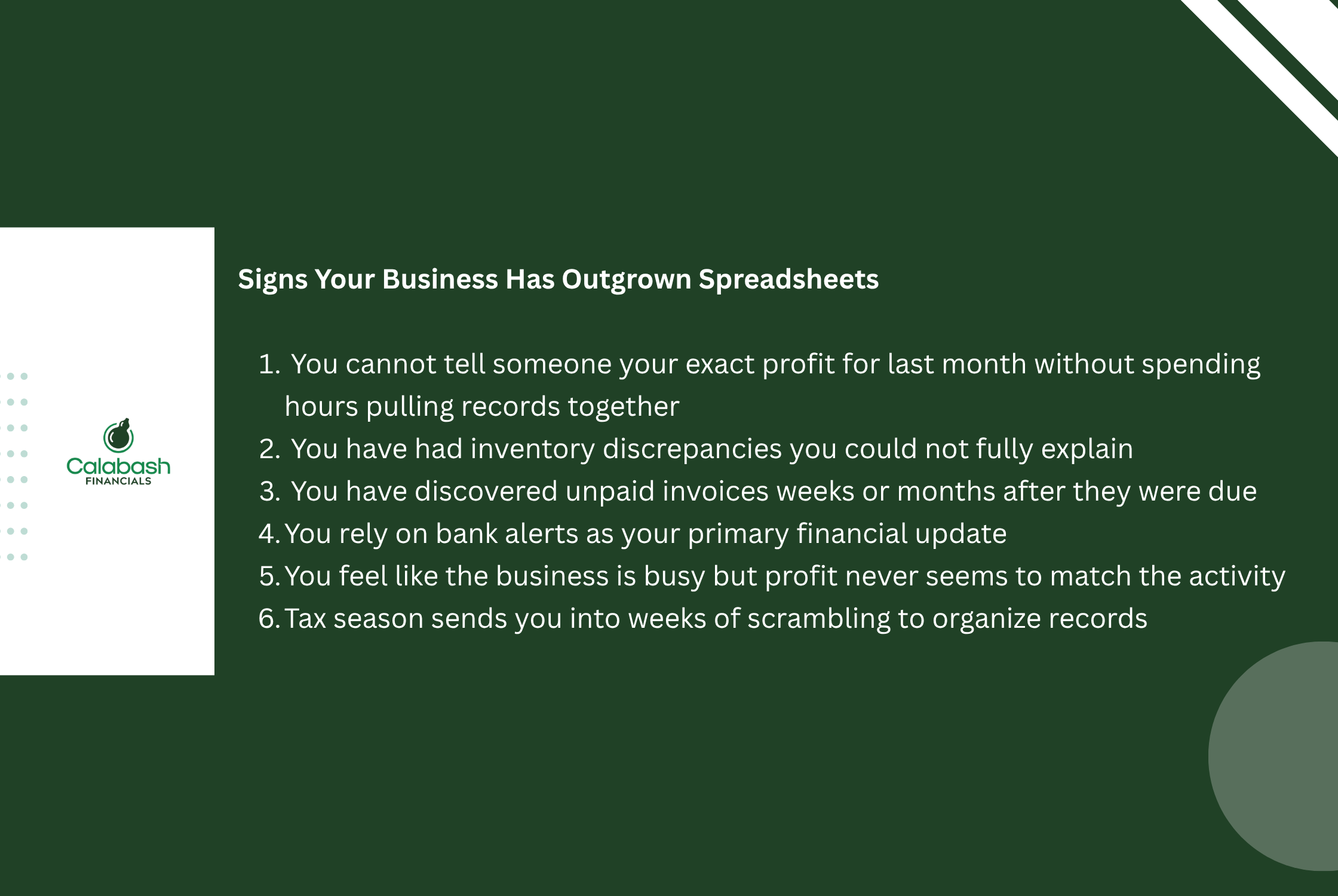
Ask any small business owner in Nigeria how they manage their finances and the answer is almost always the same; Excel, WhatsApp records, a notebook, or some combination of all three. These tools are familiar, accessible, and free. But they are not a financial system.
The problem with spreadsheets is not that they are wrong. The problem is that they are static, manual, and disconnected. Every time something changes in your business, a sale, an expense, a stock movement, a customer payment, someone has to manually update the spreadsheet. And that almost never happens in real time. Which means the spreadsheet is almost always slightly wrong, slightly out of date, and slightly misleading.
For a business processing tens or hundreds of transactions a week, that margin of error is not slight at all. It is the gap where profit disappears.
Back to Kemi and What Changed
Kemi eventually reached a breaking point. It came during a particularly painful month when she discovered that a supplier had been double-invoicing her for three months, that two of her best customers collectively owed her over ₦400,000 in unpaid balances, and that a staff member had been processing sales without recording them. None of this would have been visible on a spreadsheet. None of it showed up in her bank alerts.
What Kemi needed was not more discipline or a better Excel formula. What she needed was a system that captured every transaction, tracked every invoice, monitored every inventory movement, and gave her a live view of her business finances; automatically, without relying on anyone to update a spreadsheet.
What she needed was Calabash.
How Calabash Solves the Cash Flow Problem for Small Businesses
Calabash is a smart spend and expense management platform built specifically for the way Nigerian businesses operate. It is not a complex ERP system that requires a finance team to manage. It is not a generic accounting tool designed for a different market. It is a clean, intelligent workspace where every part of your business finances connects and updates in real time.
Real-Time Expense Tracking and Business Bookkeeping
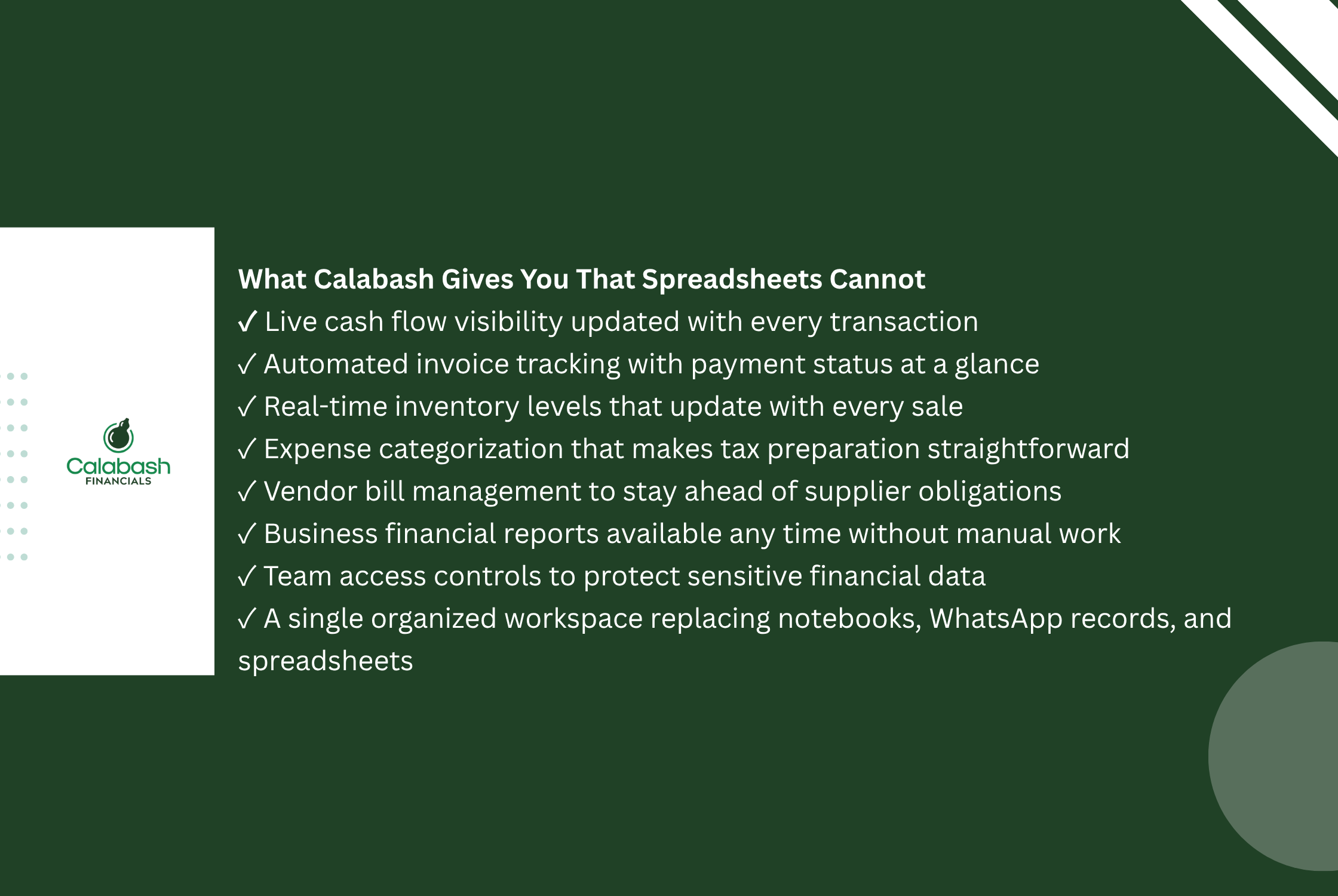
Every expense, whether paid by bank transfer, cash, or mobile money — can be recorded and categorized in Calabash the moment it happens. No more end-of-month scrambles to piece together where the money went. Your expense tracking is live, organized, and searchable at any time.
Invoice Management and Accounts Receivable Tracking
Calabash lets you send professional invoices directly to customers and track exactly which ones have been paid, which are pending, and which are overdue. No more chasing payments over WhatsApp without a record. No more forgetting who owes you what. Your accounts receivable is visible, organized, and always up to date.
Inventory Management and Stock Control
For retail and trade businesses, Calabash tracks your product catalog and inventory levels in real time. Every sale updates your stock automatically. Low inventory alerts help you reorder before you run out. And every stock movement is recorded, giving you the audit trail to identify discrepancies before they become significant losses.
Cash Flow Visibility and Business Financial Reports
Calabash generates real-time reports that show you exactly how your business is performing, revenue, expenses, profit margins, outstanding invoices, and cash position, all in one dashboard. You do not need to wait for your accountant. You do not need to build a formula. You open the app and the picture is there.
Vendor Bill Management and Accounts Payable
Calabash tracks what you owe your suppliers with the same clarity it tracks what your customers owe you. Vendor bills are recorded, categorized, and monitored so you always know your payment obligations before they become overdue, protecting supplier relationships and preventing cash flow surprises.
Team Access Controls
Growing businesses need their teams involved in operations, but not everyone should see everything. Calabash lets you give staff the specific access they need to do their jobs while keeping sensitive financial data visible only to the people who should see it.
Practical Steps to Improve Your Small Business Cash Flow Today
Whether you are just starting to take your business finances seriously or you are looking to plug the gaps in an existing system, here are the foundational steps that every small business owner should implement:
• Open a dedicated business account and route all business transactions through it.
• Not at the end of the week. Not at the end of the month. The moment it happens.
• Send an invoice the same day a job is completed or goods are delivered. Set a clear payment due date and follow up before it passes.
• A weekly review of your income, expenses, and outstanding payments takes less than 15 minutes with the right system and saves you from end-of-month surprises.
• Count your stock against your records at least monthly to catch discrepancies early.
• Never commit to a large expense, a new supplier, or a business expansion based on your bank balance alone.
• Work toward maintaining at least 4 to 6 weeks of operating expenses as a cash reserve to absorb slow months and unexpected costs.
The Right Tool Changes Everything
Kemi's boutique did not become more profitable because she worked harder. She was already working hard. It became more profitable because she could finally see what was happening inside it.
Within her first month on Calabash, she recovered over ₦600,000 in outstanding customer invoices she had lost track of. She identified a recurring supplier overcharge that had been draining her margins for months. She set up inventory tracking that made stock discrepancies visible within days rather than months. And for the first time since she opened her shop, she could look at a dashboard on her phone and know with confidence exactly how her business was performing.
That is what the right financial management system does. It does not just organize your records. It gives you control. And in business, control is profitability.
Take Control of Your Business Finances Today Join thousands of Nigerian business owners already using Calabash to track expenses, manage inventory, send invoices, and see their cash flow in real time. www.calabash.app |
Author - Sam Femi