Organising your supplier base for sanity (and cash flow)
A hundred and forty active suppliers is a category management problem whether you call it that or not. The procurement function names it one way, the AP function names it another, the treasury function names it a third. All three are talking about the same thing.
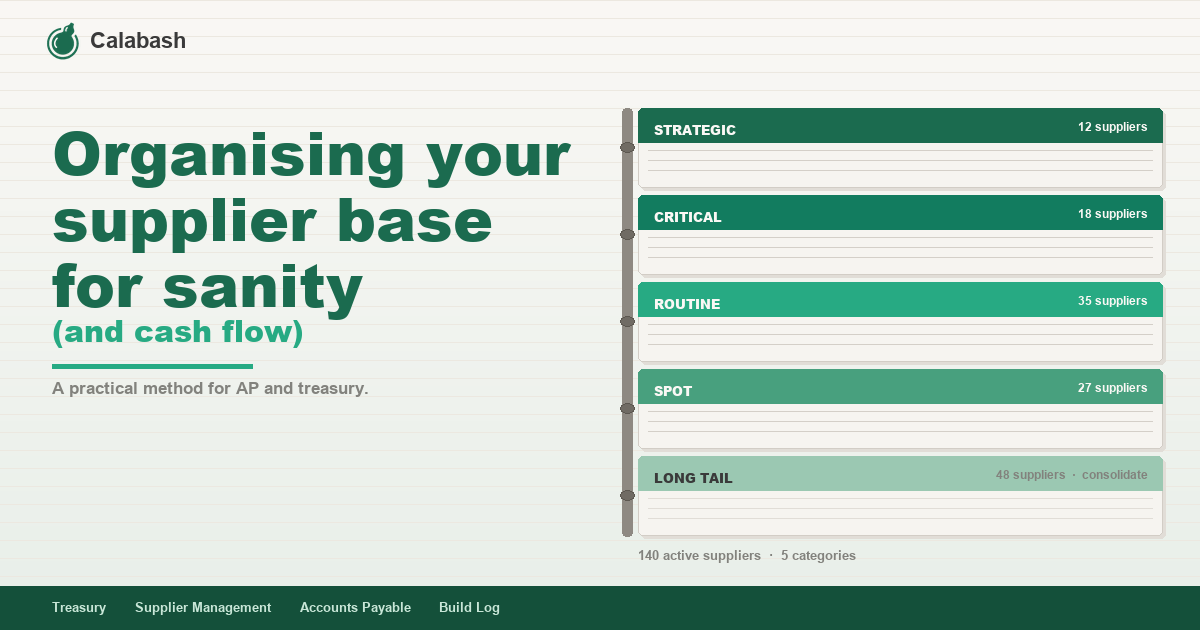
If your AP system has a hundred and forty active suppliers, you have a category management problem whether you call it that or not. The procurement function calls it categorisation. The AP function calls it "why do we have four different stationery vendors". The treasury function calls it "why is our cash forecast off again". All three are talking about the same thing.
This is a procurement-vocabulary post written for the AP and treasury people who actually have to live with the consequences.
What categorisation buys you
For procurement: better pricing, better terms, fewer suppliers to manage, more leverage in negotiations.
For AP: cleaner master data, fewer duplicate vendor records, easier reconciliation, fewer "is this the same vendor under a different name" questions at month end.
For treasury: more predictable payment cadence, easier cash forecasting, cleaner currency exposure, fewer surprise vendors showing up in the run.
The same exercise produces all three benefits. The procurement leader is the natural sponsor, but the AP and treasury teams are who feel the result of doing it well or doing it poorly.
A short practical method
This is what works for mid-market businesses we have seen. Five steps, all of them executable in a quarter by a team that takes it seriously.
Pull the spend. Export the last twelve months of supplier payments from the AP system. One row per supplier per month. If your AP data does not let you do this cleanly, that is the first problem and it is bigger than categorisation.
Cluster by what you are buying. Not by who you are buying from. The same supplier might be in two categories. The same category might have eight suppliers. Use the line-item description if you have it. Use the GL account if you do not. Keep the categories coarse at first. Office supplies. IT hardware. Professional services. Logistics. Plant and machinery. Five to ten categories at the top is plenty.
Rank by spend, risk, and strategic weight. Spend you can pull from the data. Risk and strategic weight need a thirty minute conversation with the buying lead and the head of the function being served. Some categories are big in spend but easy to switch. Some are small in spend but business-critical. Different categories warrant different effort.
Consolidate the long tail. The bottom half of your suppliers by spend almost always account for less than ten percent of total payments and more than half of your AP workload. Consolidation here is the highest-leverage move you will make. Pick a category with thirty suppliers and seven percent of spend, get it down to four suppliers, and you have just bought your AP team a week back every month.
Re-rate the bank account discipline. Every consolidated supplier is a new master data record. Every new master data record is a new opportunity to do bank account verification properly. Treat the category exercise as the moment you also clean up the supplier-bank-account file. The treasury team will be grateful for the rest of the decade.
What not to do
Do not categorise by vendor type and call it done. The point is not the labelling. The point is the consolidation, the master data cleanup, and the bank account discipline that becomes possible.
Do not start with the highest-spend category. Start with one in the middle. Get the playbook right on something where the stakes are lower, then run the same playbook on the categories where the spend is bigger.
Do not skip the AP and treasury people in the conversation. They are the ones who know which vendor records are wrong and which payment terms have drifted. Procurement leading without finance input gives you a clean spreadsheet and the same operational problems.
Why this is in a Calabash blog
Because the system we are building rewards a categorised, consolidated, well-mastered supplier base. It does not require one. It does what it does whether your supplier base is clean or messy. But the value compounds when the data underneath is in good shape. Categorisation is the cheapest, fastest way to put the data in good shape. Even if you never adopt our software, doing this exercise will pay for itself.
If you want a second pair of eyes on your spend data before you start, sign up at calabash.app/b2b and we will give you that for free. When you are ready to bring suppliers in, they register on the supplier portal at connect.calabash.app.